
- Home > All Courses > Python Automation Course
Python Automation Course
Python Automation Course – Varnik Technologies
Welcome to the industry’s most comprehensive and practical Python Automation Course, brought to you by Varnik Technologies. In today’s fast-evolving software landscape, the ability to automate testing processes is no longer just an “added bonus”—it is a mandatory skill for survival and growth.1 This course is meticulously designed to transform manual testers, fresh graduates, and non-IT professionals into high-performing Automation Engineers and SDETs (Software Development Engineers in Test).
While the demand for automation is global, the specific need for Python-based automation has skyrocketed due to Python’s simplicity, readability, and powerful library ecosystem. Our program covers everything from the absolute basics of Python programming to advanced framework development using Selenium Webdriver, PyTest, and API Automation. Delivered exclusively through Online Live Instructor-Led Training, this course brings the classroom experience to your screen, ensuring that learners in Hyderabad and across India can access premium quality education without geographical constraints.
Batch Details – Varnik Technologies
| Feature | Details |
| Trainer Name | Mr. Hemanth (Senior Python SDET & Architect) |
| Trainer Experience | 12+ Years in Automation, DevOps & CI/CD |
| Next Batch Date | Starts this Monday (Registrations Open) |
| Training Mode | Online (Live Instructor-Led Sessions) |
| Course Duration | 60 Days (Mon-Fri, 1 Hour Daily) |
| Key Technologies | Python, Selenium, PyTest, API (Requests), Jenkins, Git |
| Project Work | 2 End-to-End Live Projects (Hybrid Framework) |
| Contact Details | +917330619292 / contact@varniktecinologies.com |
| Free Demo | [Click Here to Book Your Free Demo Class] |
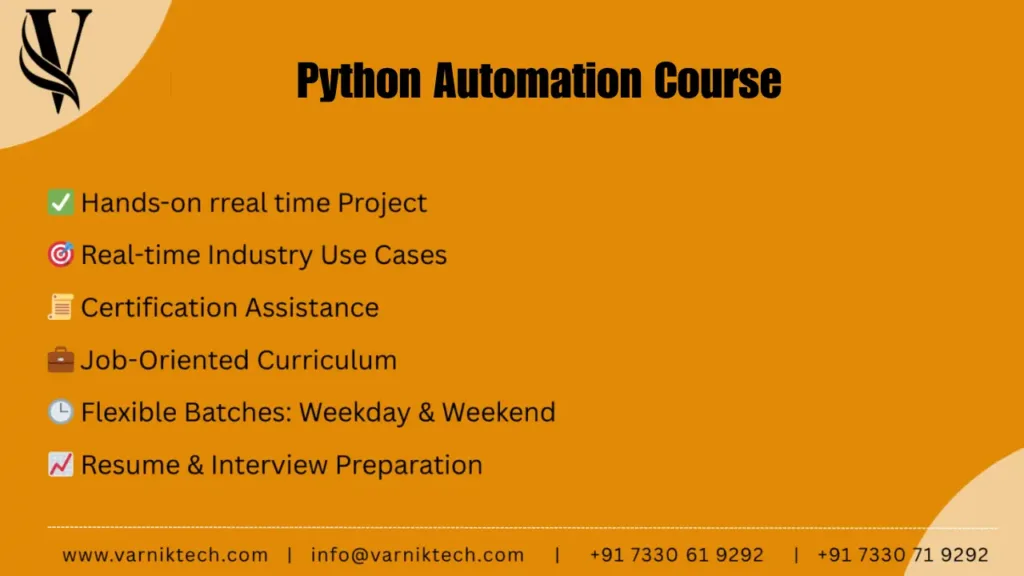
Course Overview
The Python Automation Course at Varnik Technologies is not just another coding class; it is a career-transformation program. We understand that many professionals struggle to bridge the gap between manual testing concepts and code-based automation. Therefore, our curriculum is structured to build your foundation rock-solid before moving to complex architectures.
From Zero Coding to Framework Design
Many testing professionals fear programming. We eliminate this fear by starting the course with Core Python. You will not just learn syntax; you will learn how to think like a developer. We cover data structures, control flow, functions, and Object-Oriented Programming (OOPs) concepts—all tailored specifically for testing scenarios. Once the language foundation is set, we transition smoothly into Selenium Webdriver, the industry standard for web automation.
Beyond Basic Scripting
Writing a simple script to login to a website is easy. However, building a scalable, maintainable, and robust Test Automation Framework is what defines an expert. Our course focuses heavily on framework design patterns. You will learn how to implement Data-Driven Frameworks, Keyword-Driven Frameworks, and the highly popular Page Object Model (POM). We also integrate modern tools like PyTest for unit testing, Allure for advanced reporting, and Jenkins for Continuous Integration (CI), ensuring you are ready for the modern DevOps environment.
The Online Learning Advantage
Our online delivery model is built for engagement. Unlike passive video courses where you watch and forget, our sessions are live and interactive. You code along with the instructor in real-time. If you encounter an error, we debug it together on the screen. This “pair programming” approach accelerates learning and mimics the real-world environment of agile teams.
Why Learn Python Automation in Hyderabad?
The Hub of Global Capability Centers (GCCs)
Hyderabad has firmly established itself as a premier IT hub in India, rivaling Bangalore and Pune. The city is home to massive campuses of Google, Microsoft, Amazon, and Facebook, alongside thousands of thriving startups in HITEC City and Gachibowli. These companies are aggressively moving away from legacy proprietary tools (like QTP/UFT) and adopting open-source solutions like Selenium with Python.
A Shift in the Job Market
The job market in Hyderabad is undergoing a significant shift. Recruiters are no longer hiring “Manual Testers.” The new baseline requirement is “Automation Engineer” or “Full Stack QA.” There is a massive scarcity of skilled professionals who understand Python Automation. By mastering these skills now, you position yourself in a “candidate-driven market” where companies are willing to pay a premium for the right talent. A certified Python Automation Course is your gateway to these high-paying opportunities in the local ecosystem.
Future-Proofing with AI and ML
Python is not just for automation; it is the language of Artificial Intelligence and Machine Learning.2 By learning Python for automation today, you are laying the groundwork for a future career transition into AI-based testing or Data Science. Hyderabad is rapidly becoming a center of excellence for AI, and knowing Python puts you ahead of the curve.
Why Choose Varnik Technologies?
Expert Mentorship, Not Just Training
At Varnik Technologies, our trainers are not academic professors; they are working professionals holding senior positions in top MNCs. They bring 12+ years of real-world experience into the virtual classroom. They share industry secrets, best practices, and common pitfalls that you won’t find in textbooks. When you enroll in our Python Automation Course, you are getting mentored by a future peer or manager.
Real-Time Live Projects
Theory is useless without application. Our course requires you to build two comprehensive live projects.
- E-commerce Automation: You will automate critical flows like user registration, product search, cart management, and payment gateway integration using the Page Object Model.
- API Testing Suite: You will build a backend testing framework using the Python requests library to validate REST APIs, ensuring you can handle “Headless Automation.”
Dedicated Placement Support
We don’t just teach you; we help you get hired. Our placement support includes:
- Resume Building: We help you craft a resume that highlights your new automation skills and projects, beating the Applicant Tracking Systems (ATS).3
- Mock Interviews: We conduct rigorous mock technical interviews to prepare you for the tough questions asked by top tech companies.4
- Code Reviews: Your project code is reviewed line-by-line to ensure it meets professional coding standards (PEP-8).
Advantages of Online Training
Unmatched Flexibility for Professionals
We understand that many of our students are working professionals or full-time students. Our Online Live Training allows you to upskill without quitting your job or disrupting your academic schedule. You can attend classes from your home, saving hours of productive time that would otherwise be lost in Hyderabad’s traffic.
The "Digital Library" Asset
One of the biggest advantages of our Python Automation Course is the access to recorded sessions. Every live class is recorded in HD and uploaded to your student portal. Missed a class due to a meeting? Want to revise the logic of XPath axes? Struggling with PyTest fixtures? You can simply re-watch the specific session as many times as you need. This “Digital Library” is yours to access for revision even after the course ends.
Preparing for the Remote Future
Work-from-home and hybrid models are the new normal in the IT industry.5 By learning online, you unconsciously develop the soft skills required for remote work—using collaboration tools (Zoom/Teams), managing digital communication, and self-discipline. Our online environment uses industry-standard tools like Slack and GitHub for communication and code sharing, making you “Day 1 Ready” for a remote or hybrid role.
Detailed Course Curriculum
The Python Automation Course at Varnik Technologies is rigorously structured into 10 core modules, spanning from the absolute basics of programming to advanced framework architecture. We have designed this curriculum to be “Industry-First,” meaning every concept taught is directly applicable to the day-to-day responsibilities of an Automation Engineer or SDET.
Our training methodology follows a “Crawl, Walk, Run” approach. We begin by building a strong logical foundation in Python, transition into interacting with web browsers using Selenium, and finally, master the art of building scalable frameworks that are used in top Product-Based Companies.
Phase 1 – Core Python for Testers (Modules 1-5)
Module 1: Python Environment Setup & Foundation
Before writing scripts, you need a robust development environment. We guide you through installing Python 3.x and setting up PyCharm Community Edition, the industry-standard IDE.
- Key Topics: Python installation variables, PIP (Package Installer), Virtual Environments (venv), and understanding the Python Console.
- Why It Matters: Setting up a clean environment prevents dependency conflicts in real-time projects. We also cover basic syntax and indentation rules that distinguish Python from languages like Java.
Module 2: Logic Building & Control Flow
Automation is 20% tools and 80% logic. This module focuses on training your brain to think algorithmically.
- Key Topics: Conditional statements (if, elif, else), Loops (for, while), and Loop control statements (break, continue).
- Industry Application: You will learn to write logic for scenarios like “If the ‘Buy Now’ button is disabled, check if the product is out of stock,” or “Loop through a list of search results to find a specific item.”
Module 3: Advanced Data Structures
- Key Topics:
- Lists: Managing ordered collections of web elements.
- Dictionaries: Handling Key-Value pairs (essential for working with API JSON responses).
- Tuples & Sets: Managing immutable data and unique records.
- Industry Application: We teach you how to extract data from a web table and store it in a List of Dictionaries for validation against database records.
Module 4: Modular Programming (Functions & File Handling)
Writing one long script is bad practice. We teach you to write modular, reusable code.
- Key Topics: Defining functions, passing arguments, return types, and scope of variables. We also cover File Handling (Reading/Writing .txt and .csv files) and Exception Handling (try, except blocks).
- Industry Application: You will write reusable utility functions (e.g., take_screenshot(), read_config()) that can be called across hundreds of test cases, reducing code redundancy.
Module 5: Object-Oriented Programming (OOPs)
This is the turning point of the course. OOPs is the backbone of the Page Object Model (POM) framework.
- Key Topics: Classes, Objects, Constructors (__init__), Inheritance (Single, Multilevel), Polymorphism, and Encapsulation.
- Industry Application: You will learn to treat every web page (e.g., Login Page, Home Page) as a “Class” and its elements as “Objects,” a concept that is mandatory for passing any senior-level automation interview.
Get In touch with us
Phase 2 – Selenium Webdriver Mastery (Modules 6-8)
Module 6: DOM Mastery & Locators Strategy
Selenium cannot interact with an element it cannot find. We make you an expert in the Document Object Model (DOM).
- Key Topics: ID, Name, Class Name, Link Text.
- Advanced XPath & CSS: Writing dynamic XPaths using Axes (Parent, Child, Following-Sibling, Ancestor) to locate elements that have no fixed attributes.
- Industry Application: You will learn to handle dynamic elements (e.g., IDs that change on every refresh) which is the most common challenge in modern web apps like React/Angular.
Module 7: UI Interaction & Widget Handling
Web applications are complex. This module covers interaction with various UI components.
- Key Topics: Handling Dropdowns (Static Select class vs. Dynamic Bootstrap), Checkboxes, Radio Buttons, Javascript Alerts, and Browser Windows/Tabs switching.
- Industry Application: We cover complex scenarios like handling “Shadow DOM” elements and automating calendar date pickers which are notoriously difficult for beginners.
Module 8: Synchronization & Actions Class
The #1 reason automation scripts fail is timing issues. We solve this with Synchronization.
- Key Topics: Implicit Wait vs. Explicit Wait (WebDriverWait) vs. Fluent Wait.
- Actions Chain: Simulating user gestures like Mouse Hover, Drag & Drop, Double Click, and Right Click.
- Industry Application: You will learn to write “Stable Scripts” that don’t flake out when the internet is slow or the application lags, ensuring 100% execution reliability.
Phase 3 – Framework Architecture (Modules 9-10)
Module 9: PyTest Testing Framework
Raw Selenium scripts are not “Tests” until they have assertions and reporting. Enter PyTest.
- Key Topics: PyTest installation, naming conventions, Fixtures (Setup/Teardown), Markers (grouping Smoke/Sanity tests), and Parametrization (Data-Driven testing without loops).
- Industry Application: We teach you how to run 500+ test cases in parallel using pytest-xdist to reduce execution time from hours to minutes.
Module 10: Building the Hybrid Framework
The final module brings everything together. You will build a framework from scratch.
- Key Topics:
- Page Object Model (POM): Separating page locators from test logic.
- Data-Driven Testing: Fetching test data from Excel/CSV files.
- Utilities: Integrating Logging, Screenshots on Failure, and Reading Property files.
- Industry Application: By the end of this module, you will have a “GitHub-ready” framework code that you can showcase in your portfolio.
Tools & Technologies Covered
An Automation Engineer uses more than just Python. We train you on the complete “SDET Ecosystem” to ensure you fit seamlessly into Agile teams.
- PyCharm IDE: Master debugging tools, breakpoints, and code refactoring shortcuts.
- Git & GitHub: Learn version control commands (git add, commit, push, pull, merge conflict resolution). You will push your daily code to a remote repository.
- Jenkins (CI/CD): Learn how to create Jenkins Jobs to trigger your automation scripts automatically every night (Nightly Builds) or whenever a developer pushes new code.
- Allure Reports: Move beyond basic HTML reports. Learn to generate interactive, graphical reports that show pass/fail trends, screenshots, and logs, which can be shared with stakeholders.
- Maven/PIP: Understanding dependency management to ensure your framework works on any machine.
Real-Time Projects & Practical Use Cases
At Varnik Technologies, we strictly follow a “Project-Based Learning” model. You will not just watch; you will build.
Project 1: E-Commerce Application Automation (Amazon/Flipkart Clone)
- Scenario: Automating a B2C shopping flow.
- Challenges Solved:
- Handling dynamic search suggestions.
- Validating product sorting and filtering logic.
- Managing multiple browser windows during payment gateway redirection.
- Verifying “Add to Cart” calculations and total price validation.
- Outcome: A complete POM-based framework implementing “Sanity Test Suites” for critical business flows.
Project 2: Banking/HRM Portal (Data-Driven Focus)
- Scenario: Automating an admin dashboard with massive data entry requirements.
- Challenges Solved:
- Data-Driven Testing: Using PyTest Parametrization to test the Login module with 50+ different sets of credentials (valid, invalid, SQL injection strings).
- Web Tables: Iterating through dynamic rows and columns to find and edit specific employee records.
- File Uploads: Automating resume uploads using Python os module or send_keys.
- Outcome: Mastery over handling enterprise-level applications with complex DOM structures.
Who Can Enroll in This Course?
We have tailored this course to address the specific anxieties and goals of different learner groups in Hyderabad.
Manual Testers (Career Switchers)
- The Problem: You are stuck in repetitive execution cycles with no salary growth. You fear coding because you’ve never done it.
- Our Solution: We start Python from “Hello World.” We assume zero prior coding knowledge. By learning automation, you can transition to SDET roles and potentially hike your salary by 50-100%.
Fresh Graduates (2023/2024/2025 Pass-outs)
- The Problem: The job market for “Generic Freshers” is tough. Companies want specialists.
- Our Solution: Adding “Python Automation Framework Design” to your resume makes you a specialist. You become eligible for “SDET Intern” and “Junior QA Engineer” roles that regular B.Tech graduates are not qualified for.
Non-IT Professionals
- The Problem: You want to enter the IT industry but find development (Java/.NET) too difficult and support jobs too low-paying.
- Our Solution: Python is the most human-readable language. It reads like English. Automation Testing is the perfect “Middle Path”—it requires less complex logic than software development but pays significantly better than non-technical IT roles.
Career Opportunities After Course Completion
The “Manual Testing is Dead” narrative is slightly exaggerated, but the “Manual Testing Salary Growth is Dead” narrative is 100% accurate. Transitioning to Python Automation unlocks a new tier of career opportunities in Hyderabad and global markets.
Job Roles You Can Target
Upon completing this course, your profile will match the following high-demand job descriptions on portals like Naukri, LinkedIn, and Instahire:
- Python Automation Engineer: The standard role for freshers and mid-level professionals focusing on writing test scripts.
- SDET (Software Development Engineer in Test): A premium role where you not only test but also build testing tools. This is the highest-paying profile in the QA domain.
- QA Lead / Test Architect: For experienced professionals (8+ Years) who design the automation strategy for the entire organization.
- RPA Developer (Robotic Process Automation): Your Python skills make you a strong candidate for RPA roles using tools like UiPath or Automation Anywhere.
Salary Ranges in India (2025/2026 Trends)
Based on current market data for Hyderabad, here is what you can expect:
Experience Level | Role | Average Annual Salary (INR) |
Fresher (0-2 Years) | Junior Automation Engineer | ₹4.5 LPA – ₹7.0 LPA |
Mid-Level (3-6 Years) | Senior QA / SDET I | ₹10.0 LPA – ₹18.0 LPA |
Senior (7+ Years) | Lead SDET / Architect | ₹22.0 LPA – ₹35.0 LPA |
Note: Salaries in Product-Based Companies (Google, Microsoft, Amazon) are typically 30-40% higher than the ranges above.
Certification & Learning Outcomes
At the end of the 60-Day Python Automation Course, you will not just walk away with knowledge but with tangible proof of your expertise.
- Varnik Technologies Certification: A verified certificate recognized by our network of hiring partners, validating your skills in Selenium, Python, and API Testing.
- Portfolio Building: You will possess a GitHub Repository link containing your two Capstone Projects. This “Live Portfolio” is more valuable to recruiters than any paper certificate.
- Mock Interview Scorecard: A detailed assessment report highlighting your technical strengths and areas for improvement before you sit for real interviews.
Python Automation Course
-at varnik Technologies
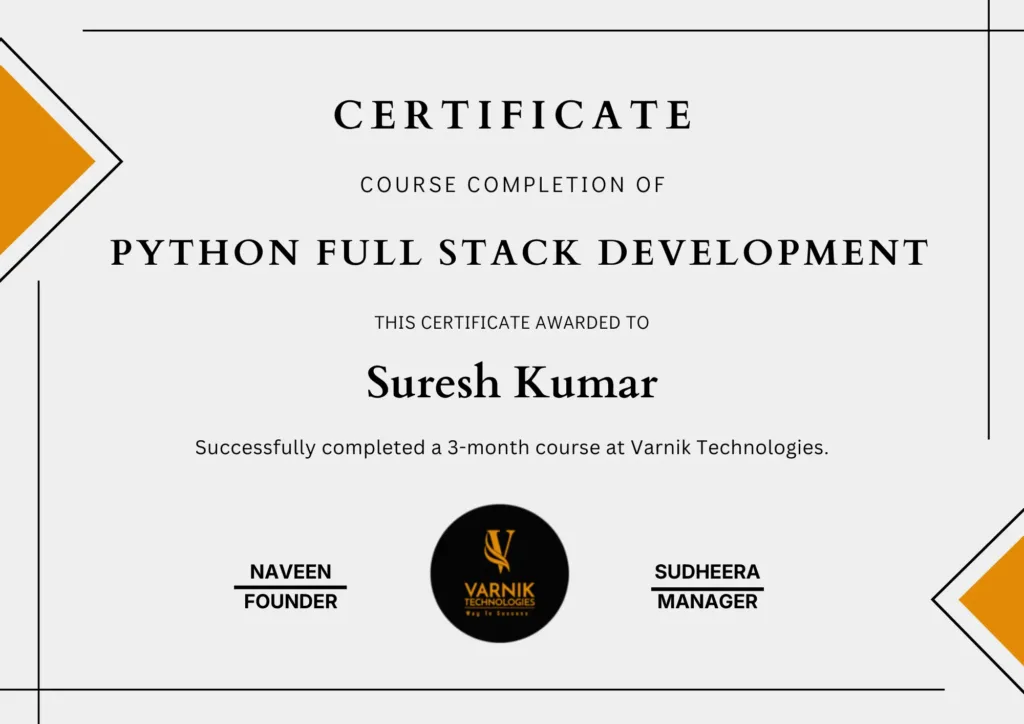
Placement & Career Support
We don’t leave you hanging after the final class. Our dedicated Placement Assistance Module ensures you are “Interview-Ready” from Day 1.
- Resume Transformation: We help you rewrite your resume to highlight “Key Skills” like PyTest, CI/CD, and Page Object Model, ensuring it passes through Applicant Tracking Systems (ATS).
- Internal Hiring Network: Varnik Technologies has tie-ups with several mid-sized IT firms and startups in Hyderabad that actively look for our trained candidates.
- Job Alerts: You will be added to our private Alumni Telegram/WhatsApp Group, where we post verified job leads for Python Automation roles daily.
Why Online Training is Best for Learners in Hyderabad
While Hyderabad is known for its classroom training culture in Ameerpet and Madhapur, Online Live Training has emerged as the superior choice for working professionals.
- Avoid the Traffic: Hyderabad’s IT corridor traffic is notorious. Save 2+ hours daily by learning from your home, using that extra time to practice coding.
- Access to Recordings: In a physical classroom, if you zone out for 5 minutes, you miss the concept forever. In our online training, you can rewind and re-watch the explanation of complex logic like Dynamic Web Tables multiple times.
- One-to-One Attention: In a crowded classroom of 50 people, hesitation stops you from asking questions. Our online tools allow you to send private chats to the instructor or share your screen immediately for error debugging.
FAQs – Python Automation Course
1. Do I need prior coding experience to join this course?
No. We start from “scratch.” The first two weeks are dedicated entirely to Core Python Programming fundamentals (Variables, Loops, Functions), designed specifically for non-coders and manual testers.
2. Why Python and not Java for Automation?
Python is gaining massive popularity because it is concise and readable. A script that takes 50 lines in Java takes only 10 lines in Python. Most AI/ML and Data Science projects also use Python, making it a more future-proof skill.
3. Will this course cover API Testing?
Yes. We cover API Automation using the Python Requests library. You will learn to automate GET, POST, PUT, and DELETE requests and validate JSON responses, which is mandatory for “Full Stack QA” roles.
4. Is this a recorded course or live training?
This is 100% Live Instructor-Led Training. You can ask questions via voice or chat instantly. We strictly avoid pre-recorded courses as they lack the engagement needed to learn coding.
5. What if I miss a live class?
Don’t worry. Every session is recorded in HD and uploaded to your student portal within 4 hours. You have lifetime access to these recordings for revision.
6. Does this course include a real-time project?
Yes, we include two major projects: an E-Commerce Automation Framework and a Banking Data-Driven Framework. You will build these from scratch, not just watch the trainer code.
7. Can I switch from a Non-IT background to IT with this course?
Absolutely. Python Automation is the easiest entry point into IT for non-engineers (B.Com, B.Sc, Civil/Mech). It requires logical thinking rather than deep computer science theory.
8. What is the duration of the course?
The course runs for 60 Days (Monday to Friday). Classes are typically held in the morning or evening to accommodate working professionals.
9. Do you provide placement guarantees?
We provide 100% Placement Assistance, which includes resume building, mock interviews, and referring your profile to our clients. While no honest institute can “guarantee” a job, we guarantee you will be skilled enough to crack interviews.
10. How do I practice if I don’t have a high-end laptop?
Python and Selenium are lightweight. Any basic laptop/desktop with 4GB RAM and Windows/Mac/Linux OS is sufficient to complete this course and the projects.
