
- Home > All Courses > Playwright Automation Online Training
Playwright Automation Online Training
Playwright Automation Online Training
– Varnik Technologies
Accelerate your career in software testing with the industry’s most comprehensive Playwright Automation Online Training, brought to you by Varnik Technologies. This course is meticulously designed to deliver expert-level, live instructor-led training to students, career switchers, and working professionals in Hyderabad and across India. We focus on transforming manual testers into high-paid Automation Architects by mastering the speed, reliability, and modern capabilities of Playwright.
Batch Details – Varnik Technologies
We believe in quality over quantity. Our Online cohorts are kept intentionally small to ensure every participant receives individual attention and mentorship.
| Feature | Details |
| Trainer Name | Mr. Nithish (Lead SDET & Architect) |
| Trainer Experience | 12+ Years in Automation (Selenium & Playwright) |
| Next Batch Date | New Batch Starting Soon (Registrations Open) |
| Training Mode | Online (Live Instructor-Led) |
| Course Duration | 45 – 50 Hours |
| Language | English |
| Contact Details | +91-7330619292 (Phone/WhatsApp) |
| Support Email | info@varniktechevents.com |
| Demo Class | [Click Here to Book a Free Demo] |
Course Overview
The landscape of software testing involves constant evolution, and Playwright has emerged as the definitive successor to legacy automation tools. At Varnik Technologies, our Playwright Automation Online Training is not just a basic tutorial; it is a deep dive into modern web engineering.
Playwright, developed by Microsoft, has revolutionized how we approach End-to-End (E2E) testing. Unlike older tools that rely on external drivers and struggle with modern web frameworks (like React, Angular, and Vue), Playwright interacts directly with the browser engine. This results in execution speeds that are significantly faster and tests that are inherently more stable.
What You Will Master in This Course:
- The Modern Automation Architecture:
Understanding the fundamental differences between Playwright and Selenium. You will learn why Playwright’s WebSocket connection offers superior speed and reliability compared to the HTTP-based JSON Wire Protocol used by legacy tools. - TypeScript & JavaScript Integration:
As the industry shifts towards a “shift-left” testing approach, testers are expected to code in the same languages as developers. Our course places a heavy emphasis on TypeScript (the industry standard for Playwright), ensuring you can write type-safe, maintainable, and scalable test code. - Handling Flakiness & Auto-Waiting:
One of the biggest pain points in automation is “flaky tests”—tests that fail intermittently. You will learn how to leverage Playwright’s intelligent Auto-Wait mechanism, which automatically waits for elements to be actionable before performing operations, effectively eliminating the need for artificial “sleep” commands. - Advanced Browser Automation:
We go beyond simple clicks. You will learn to automate complex scenarios involving Shadow DOM, iFrames, Multi-Tab Handling, and Dynamic Pop-ups. We also cover Browser Contexts, which allow you to simulate multiple incognito sessions within a single test—perfect for testing chat applications or role-based access controls. - API & Network Testing:
Modern SDET roles require more than just UI testing. Our curriculum includes dedicated modules on API Testing and Network Interception. You will learn how to mock API responses to test frontend behavior in isolation, a crucial skill for testing microservices architectures.
Why Learn Playwright Automation in Hyderabad?
Hyderabad is recognized globally as a premier IT hub, hosting a dense concentration of product-based companies, startups, and massive service-based MNCs in areas like Hitech City, Gachibowli, Madhapur, and the Financial District.
IT & Job Market Relevance in Hyderabad
The software development ecosystem in Hyderabad is aggressively modernizing. Companies here are rapidly migrating their tech stacks to modern JavaScript frameworks. Consequently, the demand for Playwright Automation Online Training has surged.
- Legacy vs. Modern: While Selenium remains in use, new projects in Hyderabad’s top tech firms are almost exclusively adopting Playwright or Cypress.
- The “Full-Stack QA” Role: Recruiters in Hyderabad are no longer looking for “Click-and-Record” testers. They seek “Full-Stack QAs” who can handle UI, API, and DB testing within a CI/CD pipeline. Playwright is the perfect tool for this hybrid role.
Demand for Automation/Testing Professionals
The career trajectory for automation engineers in Hyderabad is steep and rewarding.
- Salary Growth: Professionals skilled in Playwright and TypeScript are commanding a premium in the job market, often earning 30-40% more than their counterparts skilled only in manual testing or legacy tools.
- Recession-Proof Skills: Automation is a key enabler of DevOps. As companies look to cut costs and increase speed, they depend more on automation engineers, making this a stable and recession-resistant career path.
- Global Remote Work: Since Hyderabad is a hub for US and UK clients, mastering these tools opens up high-paying remote work opportunities where you can contribute to global projects from the comfort of your home.
Why Choose Varnik Technologies?
With hundreds of training institutes claiming to offer the best courses, Varnik Technologies distinguishes itself through a commitment to quality, practical application, and student success. We do not just teach you to code; we teach you to think like an Automation Architect.
Unmatched Trainer Expertise:
Your instructor is not a freelance tutor but a Lead SDET currently working with a Tier-1 product company. This means the knowledge you receive is current, relevant, and battle-tested. You will learn “Best Practices” that are actually used in the industry, not just theoretical concepts from a textbook.
Real-Time Projects & “Hands-On” Philosophy:
We believe that you cannot learn swimming by watching a video. Similarly, you cannot learn automation without coding.
- Live Project: You will build a Test Automation Framework from scratch for a complex E-Commerce application.
- Diverse Scenarios: You will automate scenarios involving User Authentication, Shopping Carts, Payment Gateway integration (dummy), and Order History validation.
- Framework Design: Learn to implement the Page Object Model (POM) design pattern to create reusable and maintainable code—a mandatory skill for any senior role.
Comprehensive Online Learning Support:
Our Online Training ecosystem is designed to replicate the engagement of a physical classroom.
- Daily Code Sharing: The trainer pushes code to a private GitHub repository daily, ensuring you always have working reference material.
- Instant Doubt Resolution: We utilize collaborative tools where you can share your screen, and the trainer can debug your code live during the session.
- LMS Access: You get lifetime access to our Learning Management System, which hosts session recordings, notes, and assignment solutions.
Career Guidance & Placement Assistance:
We support your journey until you get hired.
- Resume Workshop: We help you craft a resume that highlights your new skills in Playwright, TypeScript, and CI/CD, ensuring it passes through Applicant Tracking Systems (ATS).
- Mock Interviews: Participate in rigorous technical mock interviews that simulate the difficulty level of top product companies.
Advantages of Online Training
The world has moved to a digital-first model, and learning should be no different. Our Online Playwright Automation Training offers distinct advantages that make it the superior choice for learners in Hyderabad and beyond.
- Flexibility for Professionals:
We understand that working professionals have tight schedules. Our online batches are scheduled in the early mornings or late evenings to ensure you can upskill without disrupting your 9-to-5 job. - Zero Commute, More Learning:
Hyderabad traffic is notorious. By choosing our online mode, you save 2–3 hours of daily commute time. That is 10–15 hours a week that you can reinvest into practicing code and mastering the concepts. - Live Instructor-Led Experience:
This is not a pre-recorded Udemy course where you are left alone when you get stuck. These are Live, Interactive Sessions. You can stop the trainer, ask questions, discuss scenarios, and get immediate clarity. - Global Peer Group:
Our online batches attract learners from across India and abroad. This gives you the opportunity to network with peers from different companies and backgrounds, enriching your learning experience and expanding your professional network. - Cloud-Ready Skills:
Since the training is online, we naturally integrate cloud-based tools into the workflow. You will get comfortable using cloud-based repositories (GitHub/GitLab) and collaboration tools—skills that are essential for modern remote and hybrid work environments.
Detailed Course Curriculum
Our Playwright Automation Online Training curriculum is architected to take you from a novice to an expert SDET (Software Development Engineer in Test). We have structured the syllabus into three distinct levels—Beginner, Intermediate, and Advanced—to ensure a smooth learning curve, regardless of your prior coding experience.
Beginner Level Modules: Setting the Foundation
In the initial phase, we focus on building a strong foundation. Many students worry about the coding aspect, so we start from the very basics of TypeScript, the preferred language for Playwright.
Module 1: Introduction to Automation & Playwright
- Evolution of Testing: Manual vs. Automation.
- Why Playwright? Comparing architecture with Selenium, Cypress, and Puppeteer.
- Understanding the Playwright Ecosystem (Library, Test Runner, VS Code Extension).
- Lab: Setting up the Development Environment (Node.js, VS Code, Playwright).
Module 2: TypeScript for Automation
- We do not assume you know coding. We teach it.
- Variables, Data Types, and Operators.
- Functions, Arrow Functions, and Callback concepts.
- Asynchronous Programming: Understanding async and await (Crucial for Playwright).
- Classes, Objects, and Interfaces.
Module 3: Core Playwright Concepts
- Browser, Browser Context, and Page: The Hierarchy.
- Writing your first Playwright Test.
- Locators Strategy: Mastering generic and strong locators (CSS Selectors, XPath, Text, ID, Role).
- Playwright’s Smart Locators: getByRole, getByText, getByLabel.
- Handling Input Fields, Buttons, Checkboxes, and Radio Buttons.
Intermediate Level Modules: Deep Dive into Functionality
Once the basics are clear, we move to handling real-world web complexity. This section covers the scenarios you will face daily in a QA job.
Module 4: Advanced Web Interactions
- Handling Dropdowns (Static & Dynamic).
- Managing Alerts, Prompts, and Confirmation Pop-ups.
- Handling Multiple Tabs and Windows (Browser Contexts).
- Working with iFrames and Shadow DOM (A major advantage of Playwright over Selenium).
- Mouse & Keyboard Actions: Drag and Drop, Hover, Key Press events.
Module 5: Assertions & Validations
- Introduction to Playwright Assertions (expect).
- Soft Assertions vs. Hard Assertions.
- Validating Text, Attributes, Visibility, and State.
- Visual Regression Testing: Comparing screenshots to detect UI changes.
Module 6: Synchronization & Debugging
- Auto-Wait Mechanism: How Playwright automatically waits for elements.
- Explicit Waits and Timeouts.
- Debugging Tools: Using the Playwright Inspector.
- Trace Viewer: A game-changer for debugging flaky tests (recording the execution trace).
- Video Recording & Screenshot capture on failure.
Advanced Level Modules: Framework Designing & CI/CD
This is the “pro” section. Here, you learn how to build scalable frameworks and integrate them into the software delivery pipeline—skills that define a Senior Automation Engineer.
Module 7: Page Object Model (POM) Design Pattern
- Why POM? Separating logic from test scripts.
- Creating Page Classes and Test Classes.
- Implementing OOPs concepts in the Framework.
- Optimizing code reusability and maintenance.
Module 8: API Testing with Playwright
- Introduction to REST APIs (GET, POST, PUT, DELETE).
- Making API calls directly within Playwright tests.
- Validating JSON Responses and Status Codes.
- Hybrid Testing: Using API calls to set up test data (e.g., creating a user via API, then logging in via UI).
Module 9: Network Interception & Mocking
- Intercepting Network traffic.
- Mocking API responses to test edge cases (e.g., Server Down, Slow Network).
- Modifying API requests on the fly.
Module 10: Cucumber BDD Integration (Optional/Bonus)
- Writing Feature Files using Gherkin Syntax.
- Integrating Cucumber with Playwright for Behavior Driven Development.
Module 11: CI/CD & Reporting
- Generating HTML Reports.
- Integrating Allure Reports for professional dashboards.
- Jenkins/GitHub Actions: Running tests automatically on code commit.
- Parallel Execution & Cross-Browser Testing configurations.
Tools & Technologies Covered
Our Playwright Automation Online Training is not just about one tool; it covers the entire tech stack required for a modern SDET role.
- Automation Tool: Microsoft Playwright
- Programming Language: TypeScript (Primary) & JavaScript
- Runtime Environment: Node.js
- IDE: Visual Studio Code (VS Code)
- Version Control: Git & GitHub
- Build Tools: NPM (Node Package Manager)
- Reporting: Allure Reports, Playwright HTML Reports
- CI/CD: Jenkins, GitHub Actions (Overview)
- API Testing: Playwright Request Context
Real-Time Projects & Practical Use Cases
Theory is useless without application. At Varnik Technologies, the entire course revolves around building a production-grade automation framework.
Project 1: E-Commerce Web Application Automation You will automate a complex flow for a shopping platform (like Amazon or Flipkart clone).
- Scenarios: User Registration -> Search Product -> Add to Cart -> Checkout -> Payment Gateway Mocking.
- Challenge: Handling dynamic product lists, cart updates, and session management.
- Outcome: You will build a Hybrid Framework using Page Object Model (POM) and Data-Driven Testing (reading data from JSON/CSV files).
Project 2: Banking/CRM Application (Complex Forms) Focuses on handling heavy data entry, validation logic, and security features.
- Scenarios: Form validations, date pickers, file uploads, and data grid verifications.
- Challenge: Automating deeply nested iFrames and Shadow DOM elements often found in enterprise apps.
Project 3: API + UI Hybrid Implementation A realistic DevOps scenario.
- Scenario: Instead of automating the “Sign Up” UI flow (which is slow), you will use Playwright’s API request method to create a user in the backend instantly, and then use the UI to log in.
- Outcome: drastically reducing test execution time—a technique highly valued in the industry.
Who Can Enroll in This Course?
The Playwright Automation Online Training is open to anyone with a passion for technology and quality assurance.
Fresh Graduates
If you are a B.Tech, BCA, or MCA graduate looking for your first job in IT, this course is your gateway. The market is saturated with developers, but there is a talent shortage for specialized Automation Engineers. Starting your career as an SDET offers excellent packages and rapid growth.
Working Professionals (Manual/Selenium Testers)
- Manual Testers: If you are worried that your career is stagnant, this is the upgrade you need. Automation is no longer “optional”; it is mandatory for survival in QA.
- Selenium Testers: You already know automation concepts. Learning Playwright will make you a “Modern QA” capable of handling faster, more complex React/Angular applications that Selenium struggles with.
Non-IT Background Learners
Do not let the code scare you. TypeScript is one of the easiest languages to learn because it is structured and logical. We have successfully trained students from Mechanical, Civil, and Commerce backgrounds who are now working in top MNCs. We start from “Hello World,” so no prior programming knowledge is required.
Career Opportunities After Course Completion
The transition to Playwright Automation opens a wide array of high-growth career paths. As the industry standard shifts from manual testing to engineering-led quality assurance, the demand for professionals who can code and build frameworks is exploding.
Job Roles
Upon successfully completing this training at Varnik Technologies, you will be eligible to apply for the following roles in top Product and Service-based companies:
- Automation Test Engineer
- SDET (Software Development Engineer in Test)
- QA Automation Lead
- Agile Tester / DevOps QA
- Technical QA Architect
Salary Ranges in India
The salary for Playwright professionals is significantly higher than that of manual testers due to the niche skill set involving TypeScript and Framework Design.
(Note: Figures are estimates based on current market trends in Indian IT hubs like Hyderabad, Bangalore, and Pune)
| Experience Level | Role | Estimated Salary Range (INR/Year) |
| Fresher (0-2 Years) | Junior Automation Engineer | ₹ 4,50,000 – ₹ 7,00,000 |
| Mid-Level (3-6 Years) | SDET / Senior QA | ₹ 10,00,000 – ₹ 18,00,000 |
| Senior (7+ Years) | QA Architect / Lead | ₹ 20,00,000 – ₹ 35,00,000+ |
Certification & Learning Outcomes
At the end of the course, you will not just walk away with knowledge; you will have tangible proof of your expertise.
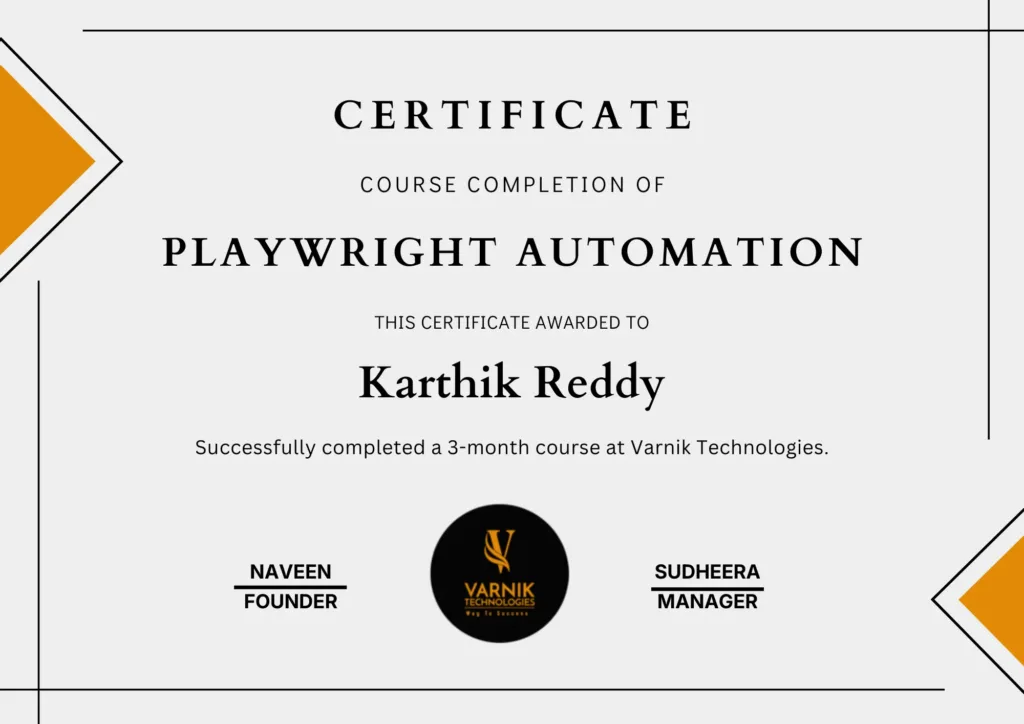
- Course Completion Certificate: You will receive a globally recognized certificate from Varnik Technologies, validating your skills in Playwright Automation with TypeScript.
- GitHub Portfolio: Unlike traditional paper certificates, you will graduate with a live GitHub repository containing your own robust Automation Framework. This “Proof of Work” is highly valued by modern recruiters.
- Skill Mastery: You will be proficient in Framework Architecture, API Testing, CI/CD Integration, and resolving complex synchronization issues in modern web apps.
Playwright Automation Online Training
– Certification
Placement & Career Support
Our responsibility extends beyond the classroom. Varnik Technologies provides a dedicated support ecosystem to help you land your dream job.
- Resume Building Workshop: We help you restructure your CV to highlight high-value keywords like End-to-End Testing, CI/CD, TypeScript, and Playwright, ensuring better visibility on job portals like Naukri and LinkedIn.
- Mock Interviews: Our trainers conduct one-on-one technical mock Interviews, simulating real corporate evaluation rounds to boost your confidence.
- Referral Network: We actively refer high-performing candidates to our network of hiring partners and alumni working in top MNCs across Hyderabad and India.
- HR Question Preparation: We prepare you for behavioral and situational questions often asked in Senior SDET interviews.
Why Online Training is Best for Learners in Hyderabad
While Hyderabad offers offline options, the Online Training model at Varnik Technologies is increasingly preferred by smart learners for distinct reasons:
- Bypass the Commute: Hyderabad’s IT corridor traffic is unpredictable. Online training saves you hours of travel time, allowing you to invest that energy into coding practice.
- Access to Best Trainers: Physical institutes are limited by geography. Our online platform brings the best working professionals directly to your screen, regardless of where they (or you) are located.
- Digital-First Learning: Since your job as an automation engineer will be performed on a computer, often in remote/hybrid settings, learning in a digital environment prepares you for the actual workspace dynamic.
Frequently Asked Questions (FAQ)
1. What is Playwright and why is it better than Selenium?
Playwright is a modern automation tool by Microsoft that supports end-to-end testing. Unlike Selenium, it is faster, auto-waits for elements (reducing flakiness), supports multi-tab/browser contexts natively, and runs without external web drivers.
2. Do I need coding experience to join this course?
No, prior coding experience is not mandatory. We teach TypeScript from scratch (variables, functions, loops) specifically for testers, making it suitable for manual testers and non-IT backgrounds.
3. Which programming language is used in this training?
We use TypeScript as the primary language because it is the industry standard for Playwright, offering type safety and better autocomplete features. We also cover JavaScript fundamentals.
4. Can Playwright be used for Mobile Application Automation?
Playwright is primarily for Web Automation (running on mobile viewports/emulators). It does not automate native mobile apps (iOS/Android .apk/.ipa) directly like Appium, but it is excellent for testing mobile-responsive web apps.
5. Does this course cover API Testing?
Yes, Playwright has built-in API testing capabilities. We dedicate specific modules to teaching you how to trigger REST API requests, validate JSON responses, and perform hybrid (UI + API) testing.
6. Will I get recordings if I miss a live class?
Absolutely. Every live session is recorded and uploaded to our Learning Management System (LMS) within a few hours. You will have lifetime access to these recordings for revision.
7. How does Playwright handle "Flaky" tests?
Playwright uses an Auto-Wait mechanism that automatically waits for elements to be actionable (visible, enabled) before performing clicks or checks. This eliminates the need for manual timeouts and reduces test flakiness significantly.
8. Is this course suitable for a Manual Tester with 5 years of experience?
Yes, this is the perfect career upgrade. Transitioning from Manual Testing to Automation (SDET) can double your career growth potential and salary. This course bridges that gap effectively.
9. Do you provide placement assistance after the course?
Yes, Varnik Technologies offers placement support including resume reviews, mock interviews, and job alerts. We guide you until you successfully crack an interview.
10. What are the system requirements for this training?
You need a laptop/desktop with at least 8GB RAM (Windows, Mac, or Linux) and a stable internet connection. All tools used (VS Code, Node.js, Playwright) are free and open-source.
