
MERN Stack Course in Delhi: What Nobody Tells You Before You Enroll
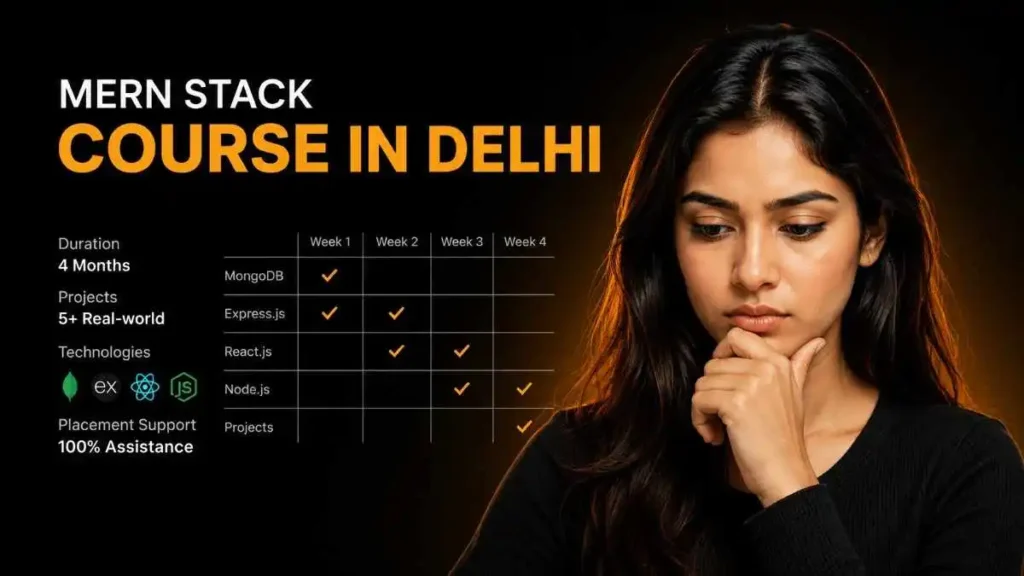
I have been training developers for a long time now, first out of Hyderabad and now we are pushing hard into Delhi NCR. Every week I get some version of the same message on WhatsApp. Someone wants to Learn MERN, someone wants a job in six months, and someone wants me to promise both without asking a single hard question first.
I am not going to do that here. This is the article I wish existed when I was mapping out our Delhi batch structure, the one that tells you what the market actually wants instead of what sounds nice on a landing page.
What Is the MERN Stack, Really
MERN stands for MongoDB, Express.js, React.js, and Node.js. It is one language, JavaScript, running across your database, your server, and your browser. That single fact is the whole reason companies love it, because they do not need three separate teams speaking three separate languages just to ship one feature.
MongoDB stores your data as flexible JSON like documents instead of rigid tables. Express.js sits on top of Node.js and handles your server logic and routing. React.js builds the interface your user actually clicks on, and Node.js runs your backend without switching out of JavaScript at all.
If you want the more technical breakdown of how these four pieces talk to each other, this explains the request response cycle well. I am not going to repeat it here. My job in this article is to tell you what happens after you understand the theory.
The Full Stack Fresher Myth, and Why It Annoys Me
I need to say something that most institutes will not say on their own website. Delhi startups almost never hire a fresher to own the entire stack from day one. They hire you for React, or they hire you for Node, and then they quietly expect you to understand how the other half works.
This is not a flaw in the system. It is just how small teams protect themselves from risk. A company with twelve engineers cannot afford to hand a brand new hire the keys to both the frontend and the backend on their first sprint.
So when we built our MERN curriculum, we stopped selling the fantasy of instant full stack mastery. We teach you to be dangerous on one side of the stack and genuinely competent enough on the other side that you are never the person in standup who says “that’s not my part.” That distinction alone changes how interviewers see you.
CRUD Is Dead, Long Live Real Time
Here is my second unpopular opinion. If your final project is a to do list app or another clone of an e commerce cart, you will blend into every other resume on the recruiter’s desk. I have watched this happen in interview rooms more times than I want to count.
Employers in 2026 are testing for real time behavior. They want to see WebSockets, live data syncing, and some understanding of how to wire an LLM API into a Node backend without the whole thing falling over under load. Our Delhi batch capstones are built around this shift on purpose.
Students build things like a live chat feature with typing indicators, or a dashboard that updates without a page refresh. It sounds small until you are the only candidate in the interview who can explain why a WebSocket connection behaves differently than a regular HTTP request.
AI Will Not Code For You, It Will Expose You
Everyone in Delhi is talking about Copilot and Cursor right now, and half of them think it means learning JavaScript from scratch does not matter anymore. I think that is backwards, and honestly a little lazy. AI tools are excellent at generating code fast, but they are terrible at knowing when the code they generated is wrong for your specific situation.
If you do not understand how the JavaScript event loop works, or why your React component keeps re rendering, AI will hand you a bug with total confidence. You will not know how to fix it because you never understood what it built. We use Copilot and Gemini in our labs, but every student still writes core logic by hand first.
That order matters more than people think. Fundamentals first, acceleration second.
MERN Stack Course in Delhi: Full Syllabus Breakdown
Our syllabus runs in four connected phases. Nothing is taught in isolation, because that is not how real projects work either.
Frontend Phase You start with React fundamentals, then move into Hooks, useState and useEffect, and component architecture. From there we go into Redux and the Context API for state management across larger apps. React Router closes out this phase so you can build proper multi page navigation.
Backend Phase This phase covers Node.js environment setup, Express.js server architecture, and building REST APIs from scratch. You will handle routing, middleware, and error handling the way production teams actually structure it, not the simplified textbook version.
Database Phase MongoDB schema design comes first, followed by Mongoose for object modeling. We cover indexing and query performance here too, because a slow database kills a fast frontend anyway.
Authentication and Deployment Phase You will implement JWT based authentication and Bcrypt for password security, the same combination most Delhi NCR product teams use. Deployment covers Vercel for frontend hosting, AWS EC2 for backend hosting, and a basic introduction to Docker and CI/CD pipelines so you are not walking into your first job blind to how code actually reaches production.
Why do we still teach Redux in 2026 when Context API exists? Because most legacy codebases in Delhi NCR product companies were built on Redux, and you will be maintaining that code long before you get to greenfield projects. Teaching only the newest tool and skipping the one companies actually run in production is how institutes create graduates who cannot get past week one.
MERN Stack Developer Salary in Delhi NCR
Numbers matter more than promises, so here is where things actually stand based on current market data.
| Experience Level | Salary Range (Delhi NCR) |
| Fresher (0 to 1 year) | 3.5 to 6 LPA |
| Mid Level (2 to 3 years) | 6 to 12 LPA |
| Senior (5+ years) | 15 to 25 LPA |
Noida tends to edge out Gurgaon slightly for fresher packages because of the density of service based IT companies in Sector 62 and Sector 63. Gurgaon pulls ahead at the mid and senior level, mostly driven by product companies and fintech startups clustered around Udyog Vihar and Cyber City. Okhla Phase 3 has quietly become a hub for smaller MERN focused startups that hire fast but pay closer to the lower end of the fresher range.
Companies in Delhi NCR Hiring MERN Stack Developers
You have three realistic entry points. Product based startups in Gurgaon and Okhla move fast, pay based on your Portfolio Strength, and expect you to learn on the job. Service based IT companies in Noida hire in larger batches with more structured onboarding, but the ceiling on fresher pay is usually lower.
Remote and freelance work has also grown a lot in the last year, especially for developers who can demonstrate real projects on GitHub instead of just certificates. None of these paths are better than the others. They just suit different personalities, and part of what we do in mock Interviews is Help Students figure out which lane actually fits them.
The Realistic Timeline From Course Completion to Offer Letter
I want to be honest about this because “100% placement” as a phrase has lost all meaning from overuse. In the current Delhi NCR market, a well prepared candidate with a strong portfolio is typically looking at a 60 to 90 day window from course completion to a signed offer letter. That is not a guarantee, it is a pattern we have watched play out across recent batches.
Candidates who skip the portfolio building phase or rush through the capstone project usually take longer. The ones who treat their final project like a real product, with a working deployment and a case for why they built it a certain way, tend to move faster.
MERN Versus MEAN, Which One Should You Learn
MEAN swaps React for Angular, and both stacks share the same MongoDB, Express, and Node foundation. React tends to win in Delhi NCR right now because more product startups use it, and because the component model is easier for freshers to pick up quickly. Angular still has a strong footing in larger enterprise environments that value its stricter structure.
If you are choosing based on job volume in Delhi specifically, MERN currently has the edge. If you already know you want to work at a large enterprise with a heavily regulated codebase, MEAN is worth a second look.
How to Choose the Right MERN Stack Institute in Delhi
Ask the institute how many hours are spent on live coding versus watching someone else code on a screen. Ask what the capstone project actually is, and ask if you can see a past student’s deployed project link, not just a certificate photo. If an institute cannot answer either question clearly, that tells you something on its own.
Watch out for “100% placement guaranteed” language without any explanation of what that guarantee actually covers. Placement assistance and a placement guarantee are two very different promises, and vague wording is usually hiding which one you are actually getting.
Frequently Asked Questions
1. What is the MERN stack used for?
MERN builds full stack web applications using one language across the entire pipeline. MongoDB handles data, Express and Node run the backend, and React builds the interface. Companies like it because one JavaScript team can own frontend and backend work together. In Delhi NCR, this makes MERN developers efficient hires for lean startup teams.
2. Is MERN stack still worth learning in 2026?
Yes, MERN remains one of the most hired for stacks in Delhi NCR right now. Demand has shifted toward real time features and AI integration rather than basic CRUD apps. Developers who pair MERN fundamentals with WebSocket and API integration skills are seeing stronger interview outcomes than those with only textbook level knowledge.
3. How long does it take to learn MERN stack from scratch?
Most learners with no prior coding background need four to six months for a solid working foundation, including a capstone project. Those with some JavaScript exposure can move faster, often in three to four months. The real variable is practice hours outside class, not just the course duration itself.
4. What is the average MERN stack developer salary in Delhi?
Freshers typically earn 3.5 to 6 LPA, mid level developers with two to three years earn 6 to 12 LPA, and senior developers cross 15 to 25 LPA. Gurgaon tends to pay slightly higher at mid and senior levels due to product company density. Noida offers more volume for fresher hiring specifically.
5. Do I need prior coding experience to join a MERN course?
No prior experience is required, but basic comfort with HTML, CSS, and JavaScript fundamentals helps you move faster. Complete beginners can still succeed with a structured starting phase. Expert insight from our batches shows students with even light scripting exposure tend to finish capstones two to three weeks earlier.
6. What is the difference between MERN and MEAN stack?
MERN uses React for the frontend while MEAN uses Angular, and both share MongoDB, Express, and Node underneath. React currently has stronger startup hiring demand in Delhi NCR. Angular still holds ground in larger enterprise environments that prefer its more rigid structure and built in tooling.
7. Which companies in Delhi NCR hire MERN stack developers?
Product based startups in Gurgaon and Okhla, and service based IT companies concentrated in Noida Sector 62 and 63, are the two biggest hiring pools. Remote and freelance opportunities have also grown significantly. Each path rewards a different kind of candidate, so understanding your own strengths early helps target the right applications.
8. Will AI coding tools replace the need to learn MERN stack fundamentals?
No, AI tools like Copilot and Cursor generate code fast but cannot judge if that code fits your specific application correctly. Developers who skip fundamentals often cannot debug what the AI produces. Employers are now testing more rigorously for core JavaScript understanding precisely because of this growing gap.
9. What projects should I build during a MERN stack course?
Skip another to do list or basic e commerce clone, since recruiters see hundreds of those. Build something with real time behavior, like live chat or a dashboard using WebSockets, or a small tool integrating an LLM API. A distinctive, deployed project is what actually gets you noticed in a stack of similar resumes.
10. How do I choose the right MERN stack institute in Delhi?
Ask about the live coding to lecture ratio and request to see an actual deployed student project, not just a certificate. Be cautious of vague “100% placement guaranteed” language without clear terms. A transparent institute will explain exactly what placement assistance covers instead of hiding behind marketing phrases.


