
- Home > All Courses > Full Stack Developer Course with Placement
Full Stack Developer Course with Placement
Full Stack Developer Course with Placement
Batch Details (Varnik Technologies)
Course Feature | Detailed Information |
Course Title | Full Stack Developer Course with Placement – Hyderabad |
Training Provider | Varnik Technologies |
Lead Trainer | Amit Verma (Senior Full Stack Developer & Technical Architect) |
Expert Credentials | 12+ Years of Experience in Full Stack Development, Java, MERN Stack, Cloud & DevOps |
Next Batch (Online) | 25th January 2026 (04:00 PM IST) – Live Instructor-Led |
Training Mode | Online (Hybrid-Global Learning Model) |
Program Duration | 3 Months (Accelerated 2026 Industry-Oriented Syllabus) |
Course Focus | Real-Time Projects, Hands-on Coding, Interview Preparation |
Placement Support | 100% Job-Oriented Training with Placement Assistance |
Direct Helpline | Call: +91 7330619292 |
Official Support Email | info@varniktech.com |
Enrollment Offer | Free Demo Class Available – Claim Your Slot Today |
Why Aspiring Developers in Hyderabad Are Switching to Online Full Stack Training
In 2026, the shift from classroom-based learning to online-first full stack developer training is being driven by how modern software teams actually work. Most product companies now operate with remote or hybrid engineering teams, using cloud-based development environments and global collaboration tools.
Enrolling in an online Full Stack Developer Course with Placement is no longer about flexibility alone—it’s about learning in the same environment used by real-world development teams.
The “New Standard”: Vranik Online vs. Traditional Hyderabad Classrooms
Traditional classroom-based institutes in areas like Ameerpet or Hitech City often rely on outdated local systems and limited lab access. These setups fail to reflect the cloud-native, scalable architectures used by companies in 2026.
Vranik’s online full stack training model offers a clear technical advantage.
1. Development Lab Access: 24/7 Cloud-Based Coding Environments
Offline institutes typically limit practice to classroom hours. In contrast, students enrolled in our Full Stack Developer Course with Placement get unlimited 24/7 access to cloud-based development labs.
You’ll work with:
- Containerized environments using Docker
- Cloud-hosted applications deployed on AWS
- Real-time API testing and CI/CD pipelines
This allows you to build, test, and deploy full-stack applications in minutes—something impossible in most physical classrooms.
2. Trainer Profile: Industry-Active Full Stack Engineers
Instead of academic-only trainers, you learn from senior full stack developers with 12+ years of real-world experience in enterprise and product-based companies.
Training focuses on:
- Production-grade coding standards
- Scalable backend architecture
- Performance optimization and debugging
- Industry best practices used in live projects
This ensures your learning is job-ready, not textbook-based.
3. Real-Time Team Collaboration & Agile Practices
Modern development is collaborative. Our online model integrates industry-standard tools directly into the curriculum:
- Git & GitHub for version control
- Jira for Agile sprint management
- Slack & Microsoft Teams for team communication
You’ll work in Agile sprint simulations, preparing you for how software teams actually operate on Day 1 of your job.
The 2026 Full Stack Developer Career Roadmap (With Placement Focus)
A full stack developer career in 2026 requires mastery across frontend, backend, databases, cloud, and deployment. Our 3-month accelerated roadmap is designed to take you from fundamentals to enterprise-ready full stack engineer.
Step 1: Programming, Web & System Foundations
Strong foundations separate average developers from high-paying professionals.
Core Programming & Web Fundamentals
You’ll master:
- HTML5, CSS3 & Modern JavaScript (ES2026)
- Object-Oriented Programming with Java
- Data structures and logical problem-solving
Linux & Developer Tooling
Since most cloud servers run on Linux, we train you in:
- Command-line navigation
- File system management
- Environment configuration
- Build tools and package managers
These skills are essential for backend and DevOps workflows.
Step 2: Backend Development & API Engineering
Backend development is the backbone of every scalable application.
Server-Side Development
You’ll work with:
- Java + Spring Boot
- RESTful API design
- Authentication & authorization (JWT, OAuth)
- Secure data handling and validation
Database & Data Management
Hands-on experience with:
- MySQL & MongoDB
- Database design & indexing
- Query optimization
- Data modeling for real-world applications
Step 3: Frontend Frameworks & Full Stack Integration
Modern applications demand seamless user experiences.
You’ll build dynamic interfaces using:
- React.js
- Component-based architecture
- State management
- API integration
This stage focuses on connecting frontend and backend into fully functional applications.
Step 4: Deployment, Cloud & Placement Readiness
Cloud & DevOps Basics
You’ll deploy applications using:
- AWS
- Docker containers
- CI/CD pipelines
- Environment-based builds
Result-Driven Placement Preparation
The final outcome isn’t just projects—it’s job readiness.
You’ll graduate with:
- Multiple real-world full stack projects
- GitHub portfolio
- Resume & interview preparation
- Mock technical interviews
- Placement assistance with hiring partners
A Deep Dive into the 12-Module Full Stack Developer Curriculum (Updated for 2026)
Our Full Stack Developer Course with Placement is structured into 12 high-impact, industry-aligned modules. These are not passive lectures—they are real-world development sprints where you design, build, deploy, and optimize full-scale web applications used in modern enterprises.
Module 1: Web & Programming Foundations
Build a strong base in modern web development fundamentals. This module focuses on how the web works at a technical level and how code executes in real environments.
What you’ll learn:
- HTML5, CSS3, JavaScript (ES2026)
- How browsers render applications
- DOM manipulation and event handling
- Clean coding standards and debugging techniques
Module 2: Advanced Java & Object-Oriented Programming
This module strengthens your backend programming skills using Java, the backbone of enterprise applications.
What you’ll learn:
- OOP principles (Inheritance, Polymorphism, Abstraction)
- Exception handling and memory management
- Collections framework
- Writing scalable and maintainable code
Module 3: Data Structures & Algorithmic Thinking
Develop logical problem-solving skills required to clear technical interviews and build efficient applications.
What you’ll learn:
- Arrays, Linked Lists, Stacks, Queues
- Trees, Hashing, and Sorting algorithms
- Time & space complexity (Big-O)
- Coding interview patterns
Module 4: Backend Development with Spring Boot
Learn how enterprise backend systems are built and scaled.
What you’ll learn:
- Spring Boot architecture
- RESTful API development
- Exception handling & validations
- Secure backend design principles
Module 5: Database Design & Management
Databases are the backbone of full stack applications. This module focuses on both SQL and NoSQL systems.
What you’ll learn:
- MySQL & MongoDB
- Database normalization
- Indexing & performance optimization
- Real-world schema design
Module 6: Frontend Development with React.js
Build modern, responsive, and dynamic user interfaces.
What you’ll learn:
- React components & hooks
- State management
- API integration
- Performance optimization techniques
Module 7: Full Stack Integration & Project Architecture
This module focuses on connecting frontend and backend into a single scalable application.
What you’ll learn:
- Frontend-backend communication
- Authentication & authorization (JWT)
- Error handling across layers
- Microservice-style architecture basics
Module 8: Version Control & Agile Development
Learn how professional development teams collaborate.
What you’ll learn:
- Git & GitHub workflows
- Branching & pull requests
- Agile & Scrum methodology
- Sprint planning and task tracking (Jira)
Module 9: Testing & Quality Assurance
Quality code is production-ready code.
What you’ll learn:
- Unit & integration testing
- JUnit & basic automation testing
- Debugging production issues
- Code reviews and best practices
Module 10: Cloud & Deployment (AWS & DevOps Basics)
Deploy applications the same way companies do in 2026.
What you’ll learn:
- AWS fundamentals
- Docker containerization
- CI/CD pipeline basics
- Application hosting and scaling
Module 11: Performance Optimization & Security Basics
Optimize applications for speed, scalability, and safety.
What you’ll learn:
- Application performance tuning
- Secure coding practices
- API security basics
- Preventing common vulnerabilities
Module 12: Capstone Projects & Placement Preparation
The final module converts your skills into job offers.
What you’ll learn:
- Real-time full stack projects
- GitHub portfolio creation
- Resume building & interview prep
- Mock interviews & placement assistance
Get In touch with us
- Talk to us
- We are happy to help you
Strategic Technical Insight: The “Shift-Left” Development Model
A defining strength of Vranik’s Full Stack Developer Course with Placement is the early introduction of Shift-Left Development practices. Instead of treating testing, performance, and security as post-development tasks, you learn to embed them directly into the coding phase.
You will integrate:
- Automated testing
- Code quality checks
- Secure coding validations
into CI/CD pipelines using modern DevOps workflows.
By detecting bugs, performance issues, and vulnerabilities during development, organizations reduce post-deployment fixes by up to 70–80%—a metric that Hyderabad’s top product companies actively evaluate while hiring full stack developers in 2026.
Vranik’s Virtual Development Lab: Code Anywhere, Anytime
Hands-on experience is the foundation of our 3-month Full Stack Developer Course with Placement. Vranik provides a browser-based Virtual Development Lab that mirrors real enterprise software environments—without requiring expensive hardware.
Enterprise-Grade Infrastructure for Learners
Unlike traditional institutes that demand high-end laptops and local setups, our infrastructure is cloud-native and scalable.
Zero-Install Coding Environments
Launch complete environments directly in your browser:
- Linux development servers
- Java + Spring Boot backends
- React frontend containers
- MySQL & MongoDB databases
24/7 Availability
Your workspace is always live. Whether you code at 2:00 AM or during office breaks, your applications, databases, and logs remain saved and accessible.
Real-World Project Environments
Work on 30+ real-world project setups, ranging from beginner CRUD apps to enterprise-grade, multi-service architectures designed by senior full stack engineers.
Snapshot-Based Debugging & Version Control Mastery
A unique feature of our 2026 lab is Snapshot-Based Development Analysis.
You can:
- Freeze application states before changes
- Compare builds before and after updates
- Identify exactly which files, APIs, or database queries caused issues
This mirrors the debugging workflow used by senior engineers in product companies, helping you think like a professional developer—not just a learner.
Full Stack Developer Certifications: Which Ones Matter in 2026?
Certifications help your resume clear ATS filters and validate your skillset to HR and technical managers. At Vranik, our Full Stack Developer Course with Placement is aligned with globally recognized certifications and job-ready competencies.
2026 Certification Comparison & ROI
Certification | Focus Area | Experience Level | 2026 Salary Range (Hyderabad) |
Oracle Java SE | Core Java & OOP | Entry | ₹5.5L – ₹8L LPA |
AWS Developer Associate | Cloud Application Development | Intermediate | ₹8L – ₹14L LPA |
React Professional | Frontend Architecture | Entry–Mid | ₹6.5L – ₹12L LPA |
Spring Professional | Enterprise Backend | Advanced | ₹12L – ₹22L LPA |
AWS Solutions Architect | Cloud & System Design | Expert | ₹18L – ₹35L+ LPA |
The Vranik Certification Roadmap
We follow a tiered, non-overwhelming approach:
- Month 1: Java + Web Fundamentals + Git
- Month 2: Spring Boot, Databases, React
- Month 3: Cloud Deployment, Capstone Projects & AWS prep
All guidance aligns with 2025–2026 certification exam patterns, including mock tests and real-world scenarios.
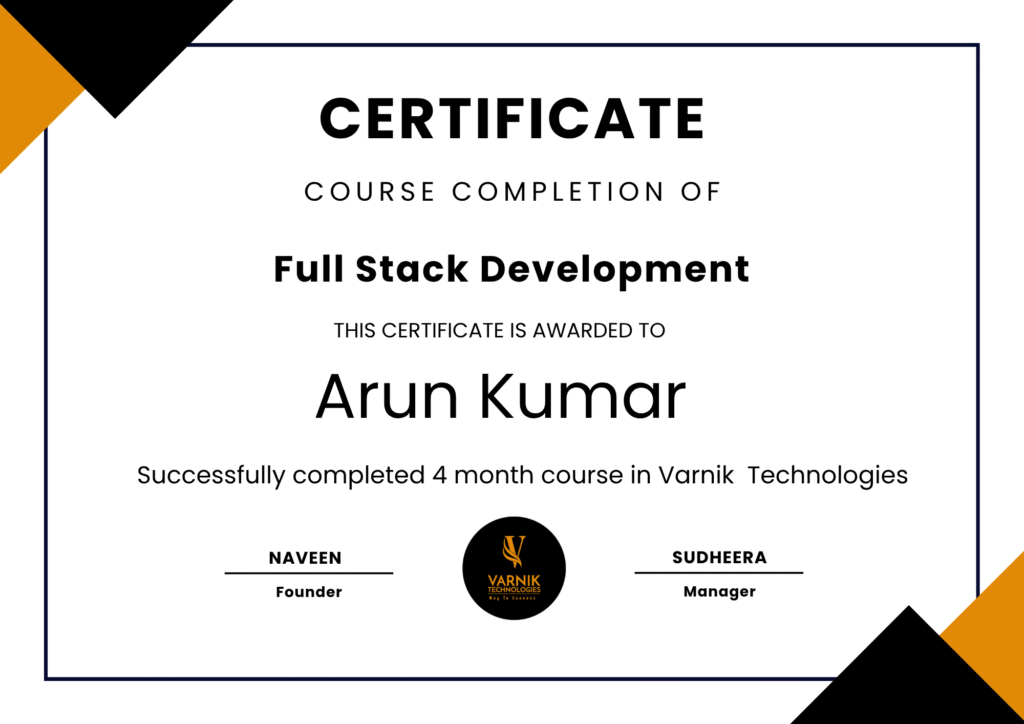
Certification for Full Stack Developer Training in Hyderabad at Varnik Technologies
Full Stack Developer Salary Report: India & Global Outlook
In 2026, full stack development has become one of the most lucrative and resilient tech careers across India and global markets. Hiring demand is driven by product companies, SaaS firms, cloud-native startups, and global MNCs such as Amazon, Microsoft, Google, Salesforce, Deloitte, and fast-growing unicorns.
Today, salary growth is no longer determined by years of experience alone. Compensation is heavily influenced by:
- Cloud readiness (AWS, Azure, GCP)
- System & application design skills
- Ability to deliver production-ready, scalable code
- Real-world project and deployment experience
Average Salary for Full Stack Developers in Major IT Corridors
India’s leading IT corridors have become strong employment hubs for full stack developers, driven by product companies, SaaS platforms, and global technology firms building scalable, cloud-native applications. Organizations increasingly seek developers who can contribute across frontend, backend, databases, and cloud deployment from Day 1.
Entry-Level Full Stack Developers (0–2 Years)
Fresh graduates and early-career professionals entering full stack roles can expect competitive compensation based on hands-on skills and project exposure.
- Average salary range: ₹5.5 LPA – ₹9 LPA
- Candidates trained in React, Java, Spring Boot, REST APIs, and basic cloud deployment typically secure packages at the higher end of this range.
- Real-time project experience and GitHub portfolios significantly improve entry-level offers.
Mid-Level Full Stack Developers (3–6 Years)
Developers progressing into independent contributor or senior developer roles see a substantial jump in compensation.
- Average salary range: ₹12 LPA – ₹24 LPA
- Higher packages are offered to professionals skilled in:
- Microservices-based architecture
- System and application design
- RESTful API development
- AWS and DevOps workflows
- Microservices-based architecture
Senior-Level Full Stack Developers (7+ Years)
Senior professionals responsible for architecture, mentoring, and technical decision-making command premium salaries.
- Average salary range: ₹30 LPA – ₹45 LPA and above
- Common roles include Technical Lead, Solution Architect, and Engineering Manager, particularly in product-based organizations.
Salary Growth in Product Engineering Hubs
Technology zones such as Bengaluru, Hyderabad, Pune, Chennai, NCR, and Mumbai are experiencing sustained demand for cloud-native full stack developers. These regions focus heavily on product development, platform scalability, and cloud-first architecture.
Specialist Skill Premium for Full Stack Developers
Developers who specialize in advanced full stack and cloud technologies typically experience faster salary growth.
- Professionals skilled in microservices architecture, cloud platforms (AWS, Azure, GCP), and containerization technologies such as Docker and Kubernetes often receive annual increments of 18 to 25 percent.
- Expertise in CI/CD pipelines and deployment automation further accelerates career progression.
Median Mid-Level Compensation
- A full stack developer with 4 to 5 years of experience earns a median annual compensation between ₹22 LPA and ₹26 LPA.
- Developers managing cloud deployments and performance optimization for large-scale applications frequently cross ₹30 LPA at the same experience level.
Location Advantage in High-Growth Tech Zones
- Cities with a high concentration of product companies and global R&D centers consistently offer higher compensation.
- Developers working in advanced product engineering roles often earn 10 to 15 percent more than peers in service-based or maintenance-focused positions across other Tier-1 cities.
Our 5-Step Placement Blueprint (India & Global Focus)
Getting hired in 2026 requires more than coding skills. Our Full Stack Developer Course with Placement follows a proven, location-agnostic hiring framework.
Phase 1: Resume Engineering & ATS Optimization
We optimize your profile with high-impact keywords used globally:
- Spring Boot
- REST APIs
- React
- AWS
- Microservices
Projects are presented with measurable outcomes, not generic descriptions.
Phase 2: Live Technical Interview Simulations
Mock interviews led by active senior developers include:
- System design discussions
- Live coding challenges
- Debugging real production issues
Phase 3: Hiring Partner & Referral Network
Profiles are shared with:
- Indian product companies
- Global SaaS firms
- Remote-first organizations
This bypasses mass job portals and increases interview conversion rates.
Phase 4: Communication & Professional Grooming
You learn to:
- Explain architecture to non-technical stakeholders
- Defend technical decisions
- Present projects with confidence
Phase 5: Post-Placement Developer Support
We provide 30 days of post-joining mentorship to help you:
- Handle production-level issues
- Understand enterprise codebases
- Adapt quickly to Agile workflows
Non-IT to Full Stack Developer: A Global Trend
Career switching into full stack development is common worldwide in 2026.
Bridge Curriculum for Career Switchers
Our structured transition path supports candidates from:
- Banking & Finance
- Sales & Operations
- Administration
- Non-technical backgrounds
Leveraging Existing Strengths
- Finance → FinTech platforms
- Operations → Business logic & workflows
- Management → Product & stakeholder understanding
90-Day Transition Plan
- Weeks 1–4: Programming & Web Fundamentals
- Weeks 5–8: Backend + Frontend Development
- Weeks 9–12: Full Stack Projects + Placement Prep
Course Fees: India vs Global Bootcamps (2026)
Region | Average Fee | Infrastructure |
USA Bootcamps | ₹9L – ₹18L | Cloud |
Europe Programs | ₹6L – ₹11L | Limited |
Varnik (India) | ₹55,000 – ₹1,45,000 | 24/7 Cloud Labs |
The Geo-Arbitrage Advantage
You receive global-level training at India-optimized pricing, saving lakhs while gaining the same cloud labs, project depth, and placement readiness.
Learner Success Stories
Case Study 1: Non-IT to Developer
A working professional from an administrative background with no prior coding experience enrolled in the Full Stack Developer Course with Placement. Starting from programming and web fundamentals, the learner progressed to Java, Spring Boot, React, and database integration. Continuous practice through cloud-based labs and real-time project development built strong technical confidence. Within 3 months, the learner secured a Junior Full Stack Developer role with a 120 percent salary increase.
Case Study 2: IT Support to Java Full Stack Developer
An IT support engineer aiming to move into core development used flexible learning schedules and night-time cloud labs to complete the Full Stack Developer Course with Placement. The learner focused on backend development, REST APIs, and cloud deployment while continuing full-time work. After 90 days of hands-on project experience and interview preparation, the learner transitioned into a Java Full Stack Developer role with a package of ₹12 LPA at a product-based company.
Online vs Classroom Full Stack Training
Feature | Traditional Classroom | Varnik Online |
Lab Access | Limited hours | 24/7 Cloud |
Content Updates | Slow | Weekly |
Trainer Access | Class-time only | Dedicated Mentor Channels |
Project Depth | Basic | Enterprise-Grade |
Tools Covered in Full Stack Developer Course with Placement
The Full Stack Developer Course with Placement provides hands-on experience with industry-standard tools used by product companies and global organizations. Training includes Java, Spring Boot, React, MySQL, MongoDB, Git, GitHub, AWS, Docker, and CI/CD pipelines, ensuring learners are fully prepared for real-world full stack development roles.

Key Highlights
150+ Live Sessions
530+ Self Paced Resources
230+ Assignments
60+ Practice & Aptitude Tests
Live Doubt Clarification
Labs For Hands-On Practice
Job Portal with 100+ Jobs
Flexible EMI Options
FAQs – Full Stack Developer Course with Placement
1. What is a Full Stack Developer Course with Placement?
A Full Stack Developer Course with Placement is a job-oriented training program that teaches frontend, backend, databases, cloud deployment, and real-time projects, along with interview preparation and placement assistance to help learners secure developer roles.
2. Who is eligible to join this Full Stack Developer Course?
This course is suitable for:
- Fresh graduates
- Working professionals
- Career switchers from non-IT backgrounds
No prior coding experience is mandatory, as fundamentals are covered from scratch.
3. What technologies are covered in the course?
The course covers:
- HTML, CSS, JavaScript
- React.js
- Java & Spring Boot
- MySQL & MongoDB
- Git & GitHub
- AWS & Docker
These tools are aligned with current industry requirements.
4. Does this course really provide placement support?
Yes. The Full Stack Developer Course with Placement includes:
- Resume & ATS optimization
- Mock technical interviews
- Real-time project portfolio
- Placement assistance with hiring partners in Hyderabad and across India
5. What kind of jobs can I get after completing this course?
After completion, you can apply for roles such as:
- Full Stack Developer
- Java Full Stack Developer
- Frontend Developer
- Backend Developer
- Software Engineer (Entry–Mid Level)
6. What is the duration of the Full Stack Developer Course?
The course duration is 3 months, designed as an accelerated, industry-focused program with live instructor-led sessions and hands-on labs.
7. Is this course available online or offline?
This Full Stack Developer Course with Placement is delivered online, using live classes, cloud-based labs, recorded sessions, and mentor support—allowing you to learn from anywhere.
8. Will I work on real-time projects during the course?
Yes. You will build multiple real-time full stack projects, including frontend interfaces, backend APIs, databases, and cloud deployment, which can be showcased in interviews.
9. What salary can I expect after completing the course?
Salary depends on skills and performance:
- Entry-level: ₹5.5L – ₹8.5L LPA
- Mid-level (with experience): ₹12L – ₹22L LPA
Candidates with strong project portfolios tend to secure higher packages.
10. Why should I choose Varnik Technologies for Full Stack training?
Varnik Technologies offers:
- Industry-experienced trainers
- 24/7 cloud-based development labs
- Job-oriented curriculum (2026 updated)
- Dedicated placement assistance
- Proven success stories in Hyderabad
