
- Home > All Courses > Data Science Online Training
Data Science Online Training
Data Science Online Training
– Varnik Technologies
Transform Your Career with India’s Most Comprehensive, Live Instructor-Led Data Science Program
Welcome to the definitive Data Science Online Training program by Varnik Technologies, designed specifically to bridge the widening gap between academic theory and industry-grade application. In an era where data is often referred to as the “new oil,” the ability to refine, analyze, and interpret this resource is the single most valuable skill a professional can possess. Our course is not just a series of lectures; it is a rigorous, career-focused bootcamp delivered entirely online, enabling learners from across India—whether in metro hubs or remote towns—to access world-class mentorship. Whether you are a fresh graduate looking for that competitive edge, a working professional seeking a salary hike, or a non-IT individual aiming for a career switch, this program is your gateway to the high-paying world of Data Science, Machine Learning, and Artificial Intelligence.
Batch Details – Varnik Technologies
Secure Your Spot in Our Upcoming Live Online Cohort
We limit our batch sizes to ensure personalized attention for every learner. Check the details below and book your demo slot immediately.
| Batch Feature | Details |
| Trainer Name | Mr. [Trainer Name] (Senior Data Scientist & AI Architect) |
| Trainer Experience | 12+ Years in Predictive Analytics, NLP, and Deep Learning |
| Next Batch Date | [Insert Date] (Admissions Closing Soon) |
| Training Mode | Online (Live Instructor-Led via Zoom/Teams) |
| Course Duration | 4 – 5 Months (In-Depth, Zero-to-Hero Curriculum) |
| Language | English (With simplified explanations for complex concepts) |
| Contact Details | +91 91600 96292 | info@varniktechnologies.com |
| Action | [Book Your Free Demo Class Today] |
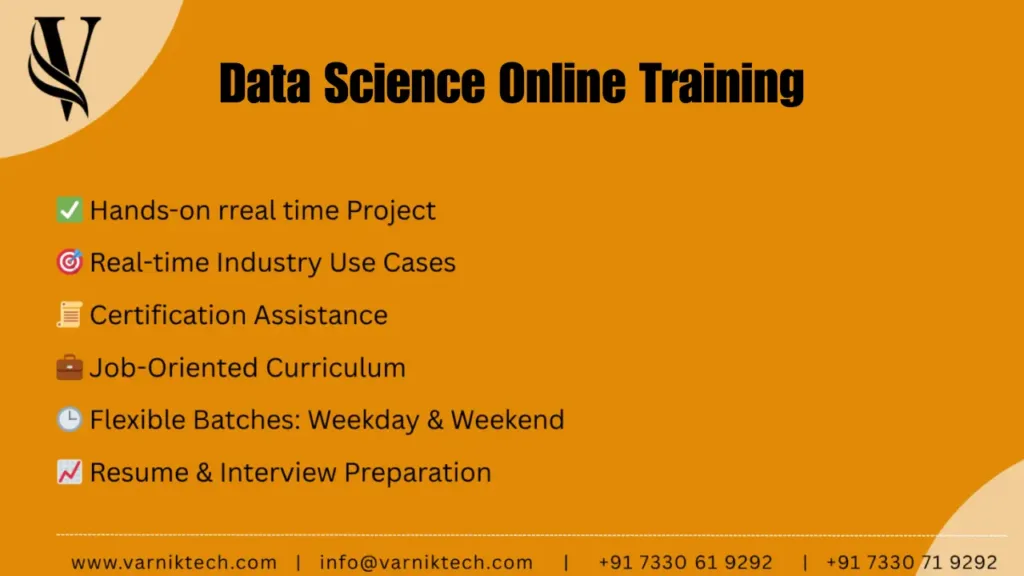
Course Overview: A Journey from Data Novice to Data Scientist
The Data Science Online Training at Varnik Technologies is meticulously crafted to replicate the lifecycle of a real-world data project. We recognize that simply knowing Python syntax is not enough to get hired. You need to understand how to solve business problems. Our “Code-First” philosophy ensures that you spend 70% of your time typing code and only 30% on theory.
This program is an immersive online experience. You will log in to live, interactive sessions where you code alongside the instructor, debug errors in real-time, and participate in brainstorming sessions that mimic corporate team meetings.
We focus on the Five Pillars of Data Science:
- Programming Mastery: We start from the absolute basics of Python. You will learn to write clean, efficient, and production-ready code. We move beyond simple “Hello World” programs to complex functions, object-oriented programming, and automation scripts that form the backbone of data engineering.
- Statistical Intuition: Many courses skip the math, but we believe it is essential. We simplify complex statistical concepts—Probability Distributions, Hypothesis Testing (T-tests, ANOVA), and Regression Analysis—so you understand why a model works, not just how to import it.
- Data Wrangling & Visualization: Real-world data is messy. You will master the art of cleaning data using Pandas and NumPy, handling missing values, and detecting outliers. Furthermore, you will learn to tell compelling stories with data using advanced visualization tools like Matplotlib, Seaborn, and an introduction to Power BI/Tableau.
- Machine Learning (The Core): This is the heart of the course. You will build predictive models from scratch. We cover the entire spectrum of Supervised Learning (Linear Regression, Logistic Regression, Decision Trees, Random Forests, SVM) and Unsupervised Learning (K-Means Clustering, PCA). You won’t just learn the algorithms; you will learn how to tune them for maximum accuracy.
- AI & Deep Learning: We future-proof your career by introducing you to the cutting edge of AI. You will get hands-on exposure to Neural Networks using TensorFlow and Keras, understanding how systems like image recognition and natural language processing (NLP) function.
Why Learn Data Science? The Global & Indian Context
The Data Revolution is Here
We are living in the age of the Zettabyte. Every swipe, click, purchase, and stream generates data. However, raw data is useless without interpretation. This is where the Data Scientist steps in.
- Netflix uses data science to recommend your next binge-watch.
- Uber uses it to calculate surge pricing in real-time.
- Amazon uses it to predict what you will buy before you even search for it.
- Banks use it to detect fraud in milliseconds.
Learning Data Science allows you to be the architect behind these intelligent systems. It is no longer a niche field; it is the operational backbone of modern industry.
Explosive Job Market in India
India is rapidly becoming the global hub for data analytics outsourcing and product development. According to recent industry reports, the demand for skilled data professionals in India has tripled in the last three years, yet the supply remains critically low.
- Recession-Proof Career: While other IT sectors face volatility, data teams are often the last to be cut because they drive revenue and efficiency.
- High Entry-Level Salaries: Data Science offers some of the highest starting salaries in the Indian IT market, often 30-50% higher than traditional software development roles.
- Cross-Industry Relevance: You are not limited to software companies. You can work in FinTech, EdTech, Healthcare, E-commerce (Flipkart/Amazon), Manufacturing, and even the Government sector.
Why Choose Varnik Technologies?
With hundreds of courses available online, why should you trust Varnik Technologies with your career? The answer lies in our unwavering commitment to student success and practical applicability. We do not sell videos; we sell a learning outcome.
- Expert Instructor-Led Training: You will be trained by a practicing Data Scientist, not a generic academic tutor. Our trainers bring real-world case studies from their own work experience into the classroom, giving you insights that textbooks cannot provide.
- Real-Time Capstone Projects: Theory doesn’t get you hired; projects do. You will work on 4-5 major projects using real datasets (e.g., Credit Card Fraud Detection, House Price Prediction, Customer Churn Analysis). These projects are designed to be showcased on your GitHub profile to impress recruiters.
- Interactive Doubt Resolution: In recorded courses, if you get stuck, you stay stuck. In our live online training, you can unmute yourself and ask questions instantly. We also have dedicated Q&A sessions to ensure no student is left behind.
- Complete Career Ecosystem: Our support doesn’t end with the last class. We provide aggressive support for resume building, LinkedIn profile optimization, and mock interviews. We teach you how to crack the specific coding tests and puzzle rounds common in Data Science interviews.
- Tool-Stack Proficiency: We ensure you are comfortable with the industry-standard tool stack, including Anaconda Distribution, Jupyter Notebooks, Google Colab, and PyCharm. You will walk into your first job feeling like an experienced professional, not a trainee.
Advantages of Online Training with Varnik
The world has moved to a remote-first work culture, and learning online is the best preparation for this new reality. Our online training model is designed to be superior to traditional offline classes in efficiency and resource availability.
- Flexibility for Working Professionals: We understand you have a job. Our batch timings are scheduled for mornings or weekends to ensure you can upskill without quitting your current employment.
- Zero Travel Time: Save hours of commute time every week. Use that extra time to practice coding or work on your projects.
- Digital Resource Library: In a physical classroom, if you miss a note, it’s gone. In our online training, every single session is recorded in HD. You get lifetime access to these recordings, along with a repository of code files, datasets, and PDF notes.
- Global Peer Group: Our online batches attract learners from all over India and abroad. This diversity enriches the learning experience, allowing you to network with peers from different backgrounds and industries.
- Comfort of Learning: Create your own distraction-free environment at home. Whether you prefer a standing desk or a bean bag, you learn in the environment where you are most productive.
Detailed Course Curriculum
At Varnik Technologies, our curriculum is not a static list of topics; it is a dynamic roadmap designed to align with the evolving demands of the global data analytics industry. We have structured this online training program to be cumulative, meaning every module builds upon the previous one. This ensures that even if you have zero programming experience, you will progress logically from basics to advanced AI implementation without feeling overwhelmed.
Module 1: The Foundation – Python & Statistics (Beginner Level)
Before diving into complex algorithms, we ensure your foundation is rock solid. This module transforms you into a capable Python programmer and a statistical thinker.
Python Environment Setup
- Installation of Anaconda Distribution, setting up Virtual Environments, and navigating Jupyter Notebooks and Google Colab for cloud-based coding.
Core Python Programming
- Syntax & Semantics: Understanding variables, dynamic typing, and operators (Arithmetic, Relational, Logical).
- Control Flow: Mastering if-elif-else logic, for loops, and while loops to automate repetitive tasks.
- Data Structures: Deep dive into Lists (indexing, slicing), Tuples (immutability), Dictionaries (key-value pairs for JSON-like data), and Sets.
- Functional Programming: Writing modular code using user-defined functions, Lambda functions, Map-Filter-Reduce, and List Comprehensions for cleaner code.
Essential Mathematics for Data Science
- Linear Algebra: Understanding Vectors, Matrices, and Dot Products (the engine behind Machine Learning).
- Calculus Basics: Concept of Derivatives and Gradients (essential for understanding how models learn).
Applied Statistics
- Descriptive Statistics: Mean, Median, Mode, Variance, Standard Deviation, and Skewness.
- Inferential Statistics: Probability Distributions (Normal, Binomial), Central Limit Theorem, Hypothesis Testing (P-Value, T-Test, Z-Test, ANOVA) to validate business assumptions.
Database Management with SQL
- Data Scientists live in databases. You will learn to write complex SQL queries to extract data, perform Joins (Inner, Left, Right, Full), and use Aggregate Functions (COUNT, SUM, AVG) and Window Functions for reporting.
Module 2: Data Engineering & Visualization (Intermediate Level)
Raw data is never clean. In this module, you learn the art of “Data Wrangling”—the process of cleaning and unifying messy, complex data sets for easy access and analysis.
NumPy (Numerical Python)
- Creating and manipulating N-dimensional arrays.
- Performing broadcasting and vectorized operations for high-speed mathematical computations that are faster than standard Python lists.
Pandas (Python Data Analysis Library)
- DataFrame Mastery: Loading data from CSV, Excel, JSON, and SQL sources.
- Data Cleaning: Handling Missing Values (NaN), detecting and treating Outliers, and fixing inconsistent formatting.
- Data Manipulation: Grouping data (groupby), Merging/Concatenating datasets, and Pivot Tables.
- Feature Engineering: Creating new variables from existing ones (e.g., extracting “Day of Week” from a “Date” column) to improve model performance.
Exploratory Data Analysis (EDA)
- The detective work of Data Science. You will learn Univariate, Bivariate, and Multivariate analysis to understand relationships between variables before building any models.
Data Visualization & Storytelling
- Matplotlib: Creating foundational plots like Line charts, Bar graphs, and Histograms.
- Seaborn: Generating advanced statistical plots like Heatmaps (for correlation), Pair Plots, Box Plots (for outlier detection), and Violin Plots to present insights visually to stakeholders.
Module 3: Machine Learning, AI & Model Deployment (Advanced Level)
This is where the magic happens. You will move from analyzing past data to predicting future outcomes using industry-standard algorithms.
Supervised Learning (Prediction & Classification)
- Linear Regression: Simple vs. Multiple Linear Regression, R-Squared, and Adjusted R-Squared.
- Logistic Regression: Predicting probabilities for binary classification (Yes/No outcomes).
- Decision Trees & Random Forests: Building robust models that can handle non-linear data; understanding Entropy and Information Gain.
- Support Vector Machines (SVM): Finding the optimal hyperplane for classification.
- K-Nearest Neighbors (KNN): Distance-based classification.
- Naive Bayes: Text classification basics (e.g., Spam Filtering).
Unsupervised Learning (Pattern Discovery)
- K-Means Clustering: Segmenting customers based on purchasing behavior.
- Hierarchical Clustering: Creating Dendrograms to visualize data groups.
- Dimensionality Reduction (PCA): Reducing 100+ features to top 10 principal components without losing information.
Model Evaluation & Tuning
- Metrics: Confusion Matrix, Precision, Recall, F1-Score, RMSE, MAE.
- Optimization: Cross-Validation (K-Fold) to prevent Overfitting/Underfitting; Hyperparameter Tuning using GridSearch and RandomSearch.
Introduction to Deep Learning (AI)
- Understanding the Artificial Neuron (Perceptron).
- Building Artificial Neural Networks (ANN) using TensorFlow and Keras.
- Basics of Computer Vision and Natural Language Processing (NLP).
Tools & Technologies Covered
A Data Scientist is only as good as their tools. We ensure you are proficient in the full “Python Data Stack.”
| Category | Tools & Libraries | Why We Teach It |
| Languages | Python 3.x, SQL | The industry standard for Analysis & Database interaction. |
| IDE / Editors | Jupyter Notebook, Google Colab, PyCharm | For interactive coding, cloud sharing, and production-grade development. |
| Data Manipulation | Pandas, NumPy | Essential for handling millions of rows of data efficiently. |
| Visualization | Matplotlib, Seaborn, Power BI (Intro) | To convert numbers into visual business intelligence. |
| Machine Learning | Scikit-Learn (sklearn) | The gold-standard library for classical ML algorithms. |
| Deep Learning | TensorFlow, Keras | For building neural networks and AI applications. |
| Version Control | Git, GitHub | Essential for team collaboration and portfolio management. |
Real-Time Projects & Practical Use Cases
Theory gets you the Interview; projects get you the job. During this online training, you will build end-to-end projects that mimic real corporate tasks.
1. BFSI Domain: Loan Default Prediction
- Problem: A bank wants to predict which customers are likely to default on their loans to minimize risk.
- Approach: You will clean historical loan data, handle imbalanced classes (using SMOTE), and build a Random Forest classifier.
- Outcome: A predictive model with >85% accuracy and a “Risk Score” for every applicant.
2. E-Commerce Domain: Customer Churn Analysis
- Problem: An e-commerce giant is losing customers to competitors. They need to know who is leaving and why.
- Approach: Perform EDA to find patterns (e.g., late deliveries causing churn) and use Logistic Regression to predict the probability of churn for current users.
- Outcome: Actionable insights for the marketing team to offer retention discounts to high-risk users.
3. Real Estate Domain: House Price Prediction (Regression)
- Problem: Predicting property prices based on location, square footage, number of bedrooms, and age of the building.
- Approach: Implement Multiple Linear Regression and Gradient Boosting Regressors.
- Outcome: A deployed web application (using Streamlit) where users enter property details and get a price estimate.
4. Retail Domain: Market Basket Analysis
- Problem: A supermarket wants to optimize store layout by understanding which products are bought together (e.g., Bread & Butter).
- Approach: Use Association Rule Mining (Apriori Algorithm).
- Outcome: Strategic product placement recommendations to increase cross-selling revenue.
Who Can Enroll in This Course?
We have designed our teaching methodology to be inclusive. We do not assume you are a computer science genius; we assume you are a dedicated learner.
Fresh Graduates (B.Tech, B.Sc, BCA, MCA)
The IT industry has shifted. Recruiters are no longer looking for generic “Java” or “C++” knowledge. They want specialized skills.
- Why Enroll: Graduating with Data Science skills puts you in a different league compared to your peers. You become eligible for “Data Analyst” and “Jr. Data Scientist” roles, which typically offer 40-50% higher starting packages than standard support roles.
Working Professionals (IT & Non-IT)
- Manual Testers / QA: Automation and AI are slowly replacing manual testing. Upskilling to Data Science is the best way to future-proof your career and move from a “Testing” role to a “Development/Analysis” role.
- Developers (Java/Mainframe/PHP): If you feel stuck in legacy technologies with stagnant growth, Data Science offers a fresh, high-growth career path.
- Non-IT (Sales, Marketing, BPO, Banking): You possess something freshers don’t: Domain Knowledge. A banker who knows Data Science is more valuable to a FinTech company than a coder who knows nothing about finance. We teach you the tech to leverage your domain expertise.
Career Gap & Women Returning to Work
- Data Science is a skill-based domain, not just an experience-based one. If you can demonstrate your skills through the projects we help you build on GitHub, companies are willing to overlook career gaps. This course gives you the portfolio you need to re-enter the workforce with confidence.
Career Opportunities After Course Completion
Data Science is currently one of the few fields where the demand for talent significantly exceeds the supply. Upon completing this online training, you are not just applying for a job; you are entering a high-growth Career Path with diverse opportunities across India and the globe.
Job Roles You Can Target
- Data Scientist: The premier role. You will build complex machine learning models to predict future trends.
- Data Analyst: The entry point for many. Focuses on cleaning data, visualizing it using SQL/Tableau, and reporting insights.
- Machine Learning Engineer: A highly technical role focused on deploying models into production and optimizing algorithms.
- Business Analyst: A bridge between the technical team and business stakeholders, interpreting data to drive business strategy.
- Data Engineer: Focuses on the architecture, building pipelines that collect and transport data (ETL).
Realistic Salary Ranges in India
Salaries in Data Science depend heavily on skills, projects, and negotiation. Based on current market standards for 2024-25:
- Freshers (0-2 Years): ₹4.5 LPA – ₹8.0 LPA
- Note: Startups often pay higher than service-based MNCs for skilled freshers.
- Mid-Level (3-5 Years): ₹10.0 LPA – ₹18.0 LPA
- Note: Professionals switching from other domains (e.g., Testing to Data Science) often land in this bracket.
- Senior Level (5+ Years): ₹20.0 LPA – ₹35.0 LPA+
- Note: Senior Data Scientists and Architects command premium packages.
Certification & Learning Outcomes
At the end of this course, you will not only have knowledge but also tangible proof of your expertise.
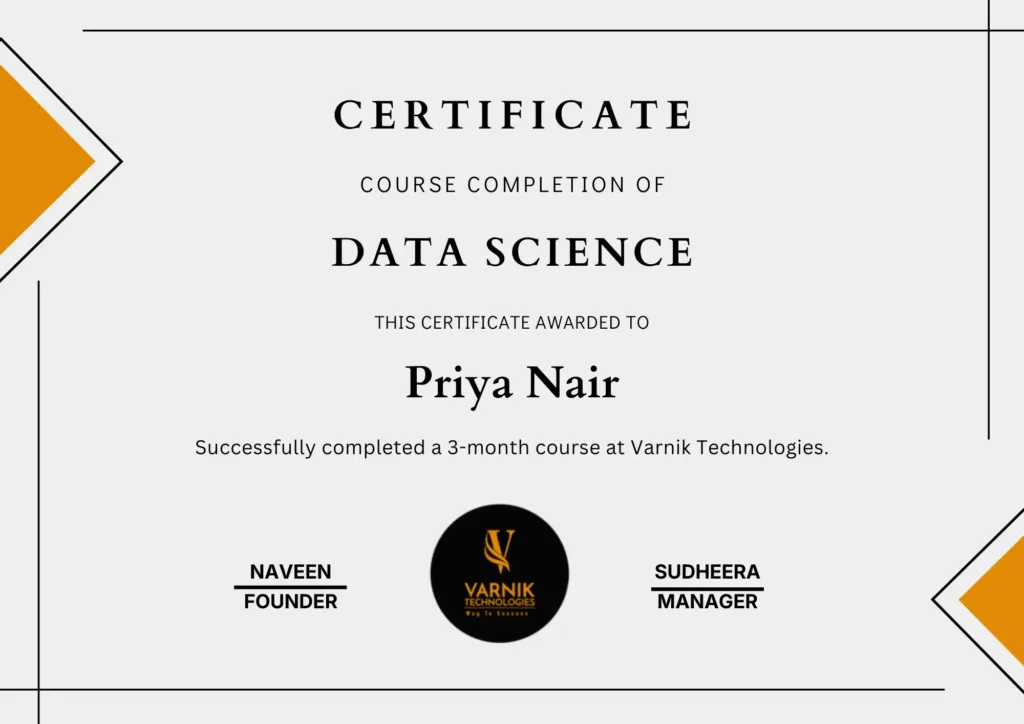
- Course Completion Certificate: You will receive a professional certificate from Varnik Technologies, validating your training in Python, Statistics, Machine Learning, and AI.
- Project Experience Certificate: Distinct validation for the real-time capstone projects you successfully deploy.
- GitHub Portfolio: unlike a paper certificate, your GitHub repository—filled with code and projects during the course—serves as live proof of your coding skills to recruiters.
- Conceptual Mastery: You will possess the ability to look at a raw dataset and immediately know which statistical test or ML algorithm to apply.
Certification for Data Science Online Training at Varnik Technologies
Placement & Career Support
Varnik Technologies is dedicated to bridging the “Last Mile” of your job search. We don’t just teach; we help you get hired.
- Resume Building: We don’t just give templates. We help you draft a data-centric resume that highlights “keywords” (like Pandas, Scikit-Learn, Regression) to pass Applicant Tracking Systems (ATS).
- Mock Interviews: One-on-one sessions with industry mentors to simulate technical rounds. We grill you on statistics and coding puzzles so you are confident in the real interview.
- LinkedIn Optimization: We guide you on how to optimize your LinkedIn profile to attract recruiters and showcase your projects effectively.
- Job Alerts: Our alumni network and placement cell actively share openings for Data Analyst and Data Science roles suitable for our trainees.
Why Online Training is Best for Learners in India
The post-pandemic world has normalized remote work and remote learning. Choosing online training with Varnik Technologies offers distinct advantages for learners across Indian cities:
- Access to Bangalore/Hyderabad Quality: You no longer need to relocate to IT hubs to get quality training. You can access the best instructors from Hyderabad and Bangalore while sitting in Pune, Delhi, Kolkata, or Tier-2 cities.
- Save Time & Money: Avoid the high cost of living in metro cities and the daily traffic grind. Invest those saved hours into practicing code.
- Digital Comfort: Since most Data Science jobs are remote or hybrid, learning online prepares you for the actual work environment where collaboration happens via Zoom and Slack.
Frequently Asked Questions (FAQ)
1. Do I need a strong programming background to join this course?
No, you do not. We start Python programming from the absolute basics (variables, loops). However, logical thinking and an interest in problem-solving are essential.
2. Is this course suitable for non-IT professionals?
Yes. Many of our most successful students come from Banking, Marketing, and BPO backgrounds. Your domain knowledge, combined with Data Science skills, makes you a unique asset to companies in your specific industry.
3. What are the system requirements for this online training?
A basic laptop with a Core i5 processor (or equivalent) and 8GB of RAM is sufficient. We will use cloud-based tools like Google Colab which run on the browser, reducing the load on your local machine.
4. How is this online training different from watching YouTube videos?
YouTube gives you information; we give you structure and mentorship. Our training is live and interactive, meaning you can ask doubts instantly. We also provide code reviews and verified projects, which self-study cannot offer.
5. Will I get recordings if I miss a live class?
Yes. Every single live session is recorded in HD. You will get access to the recording portal within 12 hours of the class completion, available for lifetime access.
6. Does Varnik Technologies provide placement guarantees?
We provide 100% Placement Assistance, not a “buying a job” guarantee. We equip you with the skills, projects, and interview prep needed to crack the job. Your effort in practicing code is the variable that determines success.
7. How much math is required for Data Science?
You need high-school level mathematics (Statistics, Probability, and basic Linear Algebra). You do not need a PhD in Math. We cover all the necessary mathematical concepts from scratch during the course.
8. Can I switch from Manual Testing to Data Science?
Absolutely. This is one of the most common career transitions. Your experience in the software lifecycle is a plus. You will move from finding bugs to finding patterns in data.
9. What is the duration of the course?
The course spans 4 to 5 months. This includes training, live coding sessions, and time allocated for project work. We prioritize depth over speed.
10. Do you cover Deep Learning and AI in this course?
Yes. While the core focus is on Data Science and Machine Learning, we include a comprehensive introduction to Deep Learning, Neural Networks, and NLP using TensorFlow/Keras to future-proof your skills.
