
- Home > All Courses > Selenium Automation Course
Selenium Automation Course
Selenium Automation Online Training in Hyderabad – Varnik Technologies
Transform your career from Manual Testing to Automation Engineering with the most comprehensive, job-oriented Selenium course in India.
Welcome to Varnik Technologies, Hyderabad’s premier destination for upskilling in IT. Our Selenium Automation with Java (or Python) course is strictly Online and Live Instructor-Led, designed to fit the busy schedules of working professionals and the ambitious goals of fresh graduates. Whether you are in Hyderabad’s tech corridors of HITEC City or joining us remotely from anywhere in India, this course is your gateway to becoming a highly paid SDET (Software Development Engineer in Test). We don’t just teach you a tool; we teach you the engineering mindset required to build robust, scalable automation frameworks that top MNCs demand.
Batch Details – Varnik Technologies
| Feature | Detailed Information |
| Trainer Name | Sudheera (Senior Automation Architect) |
| Trainer Experience | 12+ Years in Automation, SDET & DevOps Integration |
| Next Batch Date | Starts this Monday (Admissions Closing Soon) |
| Training Mode | 100% Online (Live Instructor-Led) via Zoom/Teams |
| Course Duration | 60 Days (Approx. 70–80 Hours of Intense Learning) |
| Session Timing | 7:30 AM – 8:30 AM (IST) or 8:00 PM – 9:00 PM (IST) |
| Prerequisites | No coding background required (We start from Scratch) |
| Contact Details | +91 73307 19292 | info@varniktech.com |
| Demo Class | [Click Here to Book Your Free LIVE Demo] |
Course Overview
The Selenium Automation Online Training at Varnik Technologies is meticulously crafted to solve a specific problem in the IT industry: the gap between “knowing Selenium syntax” and “building an Automation Framework.” Most courses stop at basic script writing, but today’s job market demands much more.
From Zero Coding to Automation Architect
We understand that many of our students come from Manual Testing or Non-IT backgrounds and may harbor a fear of programming. Our curriculum eliminates this fear. We dedicate the first 3 weeks exclusively to Core Java (or Python) Fundamentals. You will learn Object-Oriented Programming (OOPs) concepts—Inheritance, Polymorphism, Encapsulation, and Abstraction—not just theoretically, but specifically how they apply to Selenium automation scripts.
Complete Ecosystem Coverage
Automation is not an island; it works within a DevOps ecosystem. This course covers the full spectrum of modern QA:
- Web Automation: Deep dive into Selenium WebDriver 4.x features.
- Framework Design: Moving beyond simple scripts to creating Hybrid Frameworks using Page Object Model (POM) and Page Factory.
- Build Tools: Managing dependencies and builds using Maven.
- Test Management: organizing test suites using TestNG or JUnit.
- CI/CD Integration: Understanding how to trigger automation scripts via Jenkins.
- Version Control: Managing code collaboration with Git and GitHub.
By the end of this course, you will not just be a “tester”; you will be a developer who specializes in testing, capable of designing systems that ensure software quality at the speed of Agile.
Why Learn Selenium Automation in Hyderabad?
Hyderabad has evolved into a global epicenter for Information Technology, rivaling Bangalore in innovation and infrastructure. For IT professionals in this city, the landscape is shifting rapidly.
IT & Job Market Relevance in Hyderabad
The city is home to major IT parks like Cyber Towers, Mindspace, DLF Cyber City, and the Financial District in Gachibowli. These hubs host global giants such as Google, Microsoft, Amazon, Salesforce, and Deloitte, alongside a booming startup ecosystem in T-Hub.
Unlike the service-based era where manual testing was sufficient, these product-based companies and high-growth startups operate on CI/CD (Continuous Integration/Continuous Deployment) pipelines. They release code updates daily or weekly. In this environment, manual regression testing is a bottleneck. Consequently, the demand for manual testers is stagnating, while the demand for Automation Engineers who can facilitate these rapid releases is skyrocketing.
Demand for Automation/SDET Professionals
Data from major job portals like Naukri and LinkedIn indicates a massive surge in openings for “Selenium Automation Engineers” and “SDETs” in Hyderabad.
- Salary Arbitrage: An experienced Manual Tester with 4 years of experience might earn ₹6–8 LPA in Hyderabad. An Automation Engineer with the same experience level often commands ₹12–18 LPA.
- Job Security: As AI tools assist in code generation, the ability to validate and test that code automatically becomes more critical. Automation is a future-proof career path that offers resilience against market downturns compared to manual roles.
Why Choose Varnik Technologies?
In a market flooded with pre-recorded courses and generic training institutes, Varnik Technologies stands out by focusing on employability and practical expertise.
- Trainer Expertise (Sudheera): You are not learning from a theoretical academic. Sudheera is a practicing Senior Architect who deals with complex automation challenges daily. She brings real-world scenarios—handling dynamic WebElements, managing synchronization issues, and bypassing CAPTCHAs—into the classroom.
- Real-Time Live Projects: We do not believe in “Hello World” examples. You will work on a Live Project (simulating an E-commerce or Banking domain application). You will build the framework from scratch, write test cases, automate them, and generate reporting logs (Extent Reports). This gives you a portfolio to show recruiters.
- Interactive Doubt Resolution: Unlike Udemy or Coursera, our sessions are Live. You can stop the trainer, ask questions, and get immediate clarification. We also have dedicated Q&A sessions on weekends to debug your specific code errors.
- Comprehensive Career Guidance:
- Resume Engineering: We help you restructure your resume to highlight “Automation Competency” effectively.
- Mock Interviews: We conduct rigorous mock interviews focusing on high-probability questions asked in Hyderabad’s top tech interviews.
- Placement Support: We have a strong network of HR connections across Hyderabad and leverage these to push our students’ profiles for relevant openings.
Advantages of Online Training
The world has moved to a “Remote-First” culture, and your learning should reflect that. Varnik Technologies maximizes the benefits of online delivery:
- Flexibility & Time Management: Hyderabad traffic, especially around HITEC City and Jubilee Hills, can be draining. By choosing our Online Live Training, you save 2–3 hours of daily commute time. This is time you can invest in practicing code, which is the only way to master automation.
- Ideal for Working Professionals: Our batches are timed (early mornings/late evenings) to ensure they do not conflict with your office hours. You can upskill without quitting your job.
- Digital Asset Access: Every single class is recorded. If you miss a session due to a meeting or emergency, you can watch the recording on our LMS at your convenience. You also get lifetime access to these recordings for future revision.
- Global Peer Group: Our online model connects you with peers not just from Hyderabad, but from across India and abroad. This diversity enriches the learning experience as you see different approaches to problem-solving during group assignments.
Detailed Course Curriculum
At Varnik Technologies, our syllabus is not static; it is updated dynamically to reflect the latest changes in the Selenium 4.x ecosystem and industry expectations. We structure our learning path progressively, ensuring that you build a solid foundation before tackling complex automation architectures.
Beginner Level Modules – Core Java & Foundations
We begin with the assumption that you have zero coding knowledge. The first phase is dedicated entirely to Core Java (or Python, depending on your chosen stream), which forms the backbone of any Selenium script.
Java Environment Setup
- Installing JDK, setting up Environment Variables, and configuring Eclipse/IntelliJ IDE.
Java Basics
- Understanding Data Types, Variables, Operators, and Control Statements (If-Else, Switch, Loops).
Object-Oriented Programming (OOPs)
- A deep dive into Class, Object, Inheritance, Polymorphism, Abstraction, and Encapsulation. You will learn how these concepts map directly to automation (e.g., Inheritance for Base Classes).
String Handling & Arrays
- Manipulating string data and managing arrays/collections, crucial for handling dynamic web data.
Exception Handling
- Learning Try-Catch blocks and Throws to prevent your automation scripts from crashing due to unexpected errors.
Intermediate Level Modules – Selenium WebDriver Mastery
Once you are comfortable with coding, we move to the core tool: Selenium WebDriver. This module focuses on interacting with web browsers just like a human user would.
Selenium Architecture
- Understanding how the WebDriver API talks to the browser drivers (ChromeDriver, GeckoDriver).
Locators Strategy
- Mastering the art of identifying elements uniquely using ID, Name, Class, LinkText, and advanced CSS Selectors and XPath (including Axes methods like following-sibling, parent, etc.).
Synchronization
- Handling Textboxes, Checkboxes, Radio Buttons, and Buttons.
Synchronization
- Implementing Implicit Waits, Explicit Waits (WebDriverWait), and Fluent Waits to solve “Element Not Found” and synchronization issues in dynamic applications.
Complex User Actions
- Using the Actions Class to handle Mouse Hover, Drag and Drop, Double Click, and Right Click events.
Handling UI Components
- Automating Dropdowns (Select Class), Alerts/Popups, Frames/iFrames, and Multiple Windows/Tabs handling.
Advanced Level Modules – Framework Design & DevOps
This is the “Job-Ready” phase. Recruiters do not ask for simple scripts; they ask for Frameworks. Here, you learn to build scalable, maintainable, and robust automation suites.
TestNG Framework
- Annotations (@Test, @BeforeSuite, etc.), Grouping, Prioritizing, Parallel Execution, and Parameterization.
Data-Driven Testing
- Reading test data from external sources like Excel Sheets (Apache POI) and Properties files to run tests with multiple data sets.
Page Object Model (POM)
- Implementing the industry-standard Design Pattern to separate test logic from page objects, increasing code reusability.
Hybrid Framework Development
- Building a custom framework from scratch that combines Modular, Data-Driven, and Keyword-Driven approaches.
Reporting
- Generating rich, interactive HTML reports using Extent Reports and Allure Reports for better stakeholder visibility.
Cucumber BDD
- Introduction to Behavior Driven Development using Gherkin language (Feature files, Step Definitions) to bridge the gap between QA and Business Analysts.
Tools & Technologies Covered
To be a successful SDET (Software Development Engineer in Test), you need more than just Selenium. Our course covers the full “Automation Stack” used in modern Agile teams.
| Tool / Technology | Purpose in the Industry |
| Selenium WebDriver 4.x | The core browser automation library. |
| Core Java / Python | The programming language used to write test logic. |
| TestNG / JUnit | Unit testing frameworks for test organization and execution control. |
| Maven / Gradle | Build automation tools to manage dependencies (jars) and project structure. |
| Apache POI | Library to read/write data from Microsoft Excel for Data-Driven testing. |
| Jenkins | CI/CD tool to schedule and run automation jobs automatically (Nightly builds). |
| Git & GitHub | Version Control System to track code changes and collaborate with teams. |
| AutoIT / Robot Class | Tools to handle Windows-based popups (like file upload dialogues) that Selenium cannot touch. |
| Log4j | Logging framework to record execution steps for debugging. |
| Extent Reports | Third-party library for generating professional, graphical test reports. |
Real-Time Projects & Practical Use Cases
Theory without practice is useless in IT. At Varnik Technologies, 60% of our training time is spent on practical coding and project implementation.
The “Live Project” Experience:
We do not use dummy “Hello World” sites. You will be assigned a complex application in the E-Commerce (like Amazon/Flipkart clone) or Banking/FinTech domain.
Project Lifecycle You Will Execute:
- Requirement Analysis: You will read “User Stories” to understand what needs to be tested.
- Feasibility Study: Deciding which test cases can be automated and which should remain manual.
- Framework Setup: You will create the folder structure, configure Maven, and set up the Base Class from scratch.
- Scripting: Writing test scripts for scenarios like “User Registration,” “Add to Cart,” “Payment Gateway Integration (Mock),” and “Order History Verification.”
- Execution & CI/CD: Pushing your code to GitHub and configuring a Jenkins job to run the tests automatically every night.
- Defect Reporting: Analyzing the Extent Reports to identify failures and logging bugs.
Common Use Cases You Will Automate:
- Verifying search functionality with dynamic results.
- Validating data across multiple pages (Pagination).
- Handling “Ajax” loaders and dynamic elements that appear without page refresh.
- Cross-Browser Testing (running the same test on Chrome, Firefox, and Edge simultaneously).
Who Can Enroll in This Course?
This course is structured to be inclusive, catering to various career stages. Whether you are starting out or looking to pivot, our curriculum adapts to your needs.
Fresh Graduates (B.Tech, BCA, MCA, B.Sc)
If you are a 2023, 2024, or 2025 pass-out looking for your first break in the IT industry, this course is your fast track.
- Why You? Companies are reluctant to hire freshers who only know theory. Having a “Selenium Automation” project on your resume proves you are “billable” from Day 1.
- Outcome: You will be eligible for roles like “Associate Software Engineer” or “QA Trainee.”
Working Professionals (Manual Testers)
For Manual Testers with 2–8 years of experience, the industry message is clear: Automate or Stagnate.
- Why You? You already know the Functional side of testing. Adding Automation skills makes you a “Full-Stack QA.” This is the only way to break the salary glass ceiling and move into Senior QA or SDET roles.
- Outcome: Transition to “Senior Automation Engineer” or “QA Lead” roles with a potential 50–100% salary hike.
Non-IT Background Learners
If you are from a BPO, KPO, Civil, Mechanical, or Teaching background and want to switch to IT, Testing is the easiest entry point.
- Why You? Unlike Development roles that require complex algorithmic knowledge, Automation Testing is logic-based but more accessible. Our “Core Java from Scratch” module is specifically designed to help you bridge the gap.
- Outcome: A successful career switch into a high-growth IT sector with a respectable starting package.
Career Opportunities After Course Completion
The transition from Manual Testing to Automation is not just a skill upgrade; it is a lifestyle upgrade. By mastering Selenium, you open doors to the most lucrative profiles in the software industry.
Job Roles You Can Target
Upon completing the Selenium Automation Online Training at Varnik Technologies, you will be eligible for the following designations:
- Automation Test Engineer: The standard role for professionals with 1–4 years of experience.
- SDET (Software Development Engineer in Test): A high-demand role where you are treated on par with developers.
- QA Lead / Automation Architect: Senior roles focused on designing frameworks and managing teams.
- RPA (Robotic Process Automation) Developer: Selenium skills form a strong base for shifting into RPA tools like UiPath or BluePrism.
Salary Ranges in India (2025–2026)
Based on current market data for Hyderabad, Bangalore, and Pune:
| Experience Level | Role | Estimated Salary Range (INR) |
| Freshers (0–1 Year) | QA Trainee / Jr. Automation Engineer | ₹3.5 LPA – ₹6.0 LPA |
| Mid-Level (2–5 Years) | Sr. Automation Engineer | ₹8.0 LPA – ₹16.0 LPA |
| Senior/Architect (6–10+ Years) | SDET II / QA Lead | ₹18.0 LPA – ₹32.0 LPA |
| Specialist | SDET III (Product Companies) | ₹40.0 LPA+ |
Note: Salaries in product-based companies (Google, Amazon, Microsoft in Hyderabad) are significantly higher than service-based firms.
Certification & Learning Outcomes
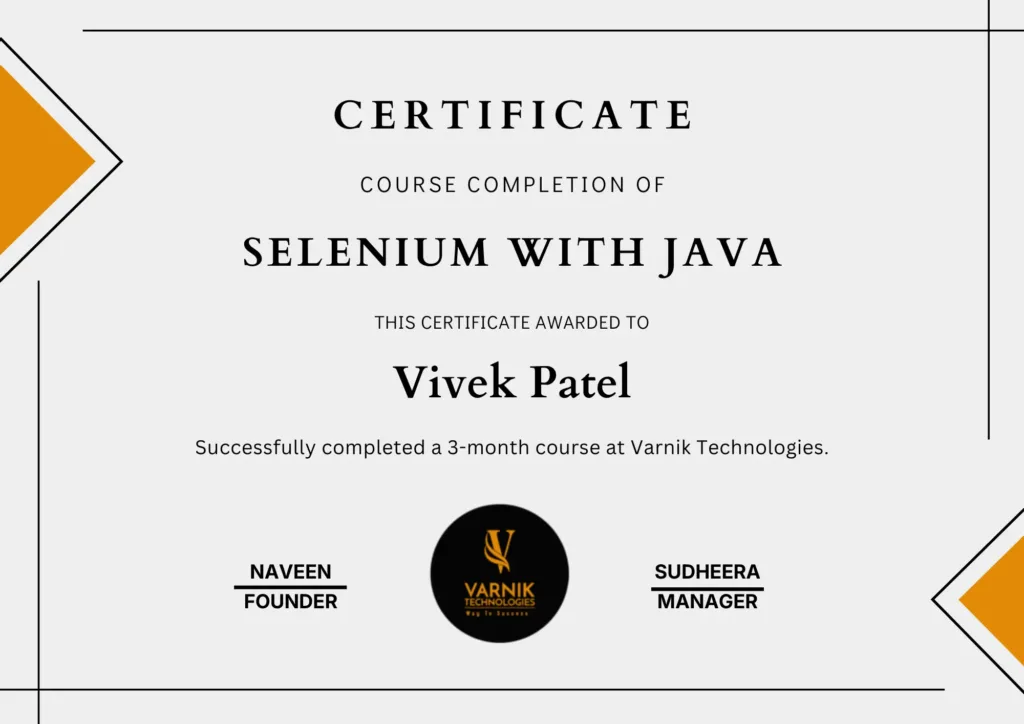
Varnik Technologies Course Completion Certificate
At the end of the course, you will receive a verifiable certificate that validates your expertise in Selenium 4.x, Java, and DevOps Tools. This certificate is recognized by our hiring partners and serves as a badge of your practical skills.
Key Learning Outcomes:
- Ability to build a Hybrid Automation Framework from scratch.
- Proficiency in Core Java specifically for automation logic.
- Hands-on experience with CI/CD pipelines (Jenkins/Git).
- Confidence to clear technical interviews for SDET roles.
Certification for Selenium Automation Course at Varnik Technologies
Placement & Career Support
Our relationship doesn’t end with the last class. Varnik Technologies is committed to helping you land your dream job.
- Resume “Surgery”: We don’t just review resumes; we dissect them. We help you replace generic phrases like “Knowledge of Selenium” with powerful impact statements like “Designed a Data-Driven Framework reducing regression time by 40%.”
- Mock Interviews: Conducted by working professionals from top MNCs in Hyderabad. We simulate the actual interview pressure to ensure you are ready for the real thing.
- Referral Network: We actively refer high-performing students to our network of clients and recruitment partners in HITEC City, Gachibowli, and Madhapur.
Why Online Training is Best for Learners in Hyderabad
- Traffic is the Enemy: In Hyderabad, commuting from areas like Kukatpally or Secunderabad to HITEC City can take hours. Online training gives you back that time.
- Late-Night Lab Access: Our labs are virtual. You can practice coding at 11 PM or 5 AM—whenever your brain is most active, without waiting for a physical institute to open.
- Weather-Proof Learning: Heavy rains in Hyderabad often disrupt physical classes. Our online live sessions continue uninterrupted, ensuring your course finishes on time.
Frequently Asked Questions (FAQ)
1. Do I need coding experience to join this Selenium course?
No. We teach Core Java from absolute scratch (Variables, Loops, OOPs) for the first 3 weeks. The course is specifically designed for manual testers and non-IT students with zero programming background.
2. Is this training purely theoretical or practical?
It is 70% practical. You will not just watch videos; you will write code daily. By the end of the course, you will have built a working Automation Framework on your own laptop.
3. What if I miss a Live Class?
Every session is recorded and uploaded to our LMS portal within 4 hours. You can watch the recording at your convenience and ask doubts in the next live session.
4. Will you provide placement assistance?
Yes. We provide 100% placement assistance. This includes resume building, mock interviews, and sharing your profile with our hiring network. However, clearing the interview depends on your practice and effort.
5. How is "Varnik Technologies" different from other institutes in Ameerpet?
We focus on Quality over Quantity. Our trainers are working professionals (Architects/SDETs), not full-time faculty who haven’t coded in years. We teach current industry standards like Git, Jenkins, and Docker integration, not just basic record-and-playback.
6. Can I switch from a Non-IT background to Automation Testing?
Yes, absolutely. Many of our successful students come from BPO, Teaching, or Mechanical Engineering backgrounds. The key is consistent practice of the Java concepts we teach.
7. Do you cover Python with Selenium?
Our primary batch focuses on Selenium with Java as it has the highest job market demand (70% of openings). However, we do offer separate cohorts for Selenium with Python upon request.
8. What is the duration of the course?
The course runs for 60 days (approx. 2 months). Classes are held Monday to Friday, with occasional doubt-clearing sessions or hackathons on weekends.
9. Will I work on a Real-Time Project?
Yes. You will automate a live E-commerce or Healthcare application. You will handle real challenges like dynamic XPaths, iFrames, and Captchas, giving you talking points for your interviews.
10. What laptop configuration do I need?
A basic laptop with 8GB RAM and an i3/i5 processor is sufficient. We will help you install all necessary free software (Eclipse, JDK, Maven) during the first week.
