
- Home > All Courses > Selenium With Java Training
Selenium With Java Training
Selenium with Java Training in Hyderabad – Varnik Technologies
Selenium with Java is currently the undisputed king of the automation testing world, serving as the primary skill required for high-paying SDET (Software Development Engineer in Test) roles. This Selenium with Java Online Training by Varnik Technologies is meticulously designed for learners in Hyderabad and across India who wish to master automation testing from the ground up. Whether you are a manual tester looking to hike your salary or a fresh graduate aiming for a top-tier IT job, our Live Instructor-Led Online Course provides the practical, coding-intensive training necessary to crack interviews at top MNCs.
Batch Details – Varnik Technologies
| Feature | Details |
| Trainer Name | Sudheera (Senior Automation Architect) |
| Trainer Experience | 12+ Years in Automation & Framework Design |
| Next Batch Date | Starts this Monday (New Batch) |
| Batch Timing | 7:30 AM – 9:00 AM (IST) or 8:00 PM – 9:30 PM (IST) |
| Training Mode | Online (Live Interactive Sessions via Zoom) |
| Course Duration | 60 Days (approx. 70-80 Hours of Content) |
| Language | English (with clear explanations) |
| Contact Details | +91 7330719292 | info@varniktech.com |
| Demo Class | [Click Here to Register for Free Demo] |
Course Overview
The Selenium with Java Course at Varnik Technologies is not just about learning a tool; it is about becoming a complete Automation Engineer. Many institutes in Hyderabad rush through the concepts, covering only the “Happy Path” scenarios. At Varnik, we focus on the “Real-Time” challenges that testers face in actual projects.
Our online training curriculum is divided into three major pillars:
1. Core Java for Non-Programmers (The Foundation)
The biggest fear for manual testers is coding. We eliminate this fear. We assume you have Zero Coding Knowledge.
- We start from the very basics: What is a Class? What is an Object? What are Variables?
- We spend the first 20 days exclusively on Core Java, covering Loops, Arrays, Strings, Collections (List, Set, Map), and OOPS concepts (Inheritance, Polymorphism, Encapsulation, Abstraction).
- By the end of the Java module, you will be writing logical programs confidently, which is the primary requirement for Selenium.
2. Selenium WebDriver & Framework Design (The Core)
Learning to click a button using Selenium is easy; building a scalable framework is hard. We teach you the hard part.
- Selenium 4 Features: We cover the latest updates, including Relative Locators and CDP (Chrome DevTools Protocol) integration.
- Locators Strategy: Master Xpath and CSS Selectors so you never have to rely on record-and-playback tools.
- Frameworks: You will learn to build Data-Driven, Keyword-Driven, and Hybrid Frameworks using the Page Object Model (POM) design pattern.
3. The Ecosystem (DevOps & CI/CD)
In 2026, knowing just Selenium is not enough. You must know the ecosystem surrounding it.
- Maven: For build management and dependency handling.
- TestNG: For controlling execution flow, grouping tests, and generating reports.
- Jenkins: To schedule and run your tests automatically (CI/CD pipelines).
- Git & GitHub: For version control and code collaboration.
Why Learn Selenium with Java in Hyderabad?
Hyderabad has transformed into the “Silicon Valley of India” alongside Bangalore, and the job market here has undergone a massive shift regarding Software Testing.
IT & Job Market Relevance in Hyderabad
- The Shift from Manual to Automation:
Ten years ago, you could easily get a job in Ameerpet or Madhapur with just Manual Testing knowledge. Today, that is nearly impossible. Companies in Hyderabad’s premier tech parks—like Mindspace, DLF Cyber City, and Financial District—have mandated automation skills. Even for functional testing roles, recruiters expect candidates to read and execute automation scripts. - Higher Packages for SDETs:
The salary disparity is massive. A manual tester with 3 years of experience in Hyderabad might earn ₹4-6 LPA. However, an Automation Engineer (SDET) with the same experience easily commands ₹9-14 LPA. Learning Selenium with Java is the single most effective way to double your package in the Hyderabad market. - Startup Ecosystem:
Hyderabad is home to T-Hub and hundreds of flourishing startups. These startups do not hire separate teams for manual and automation testing. They look for “Full Stack QA” professionals who can do it all. This course makes you that person.
Demand for Automation/Testing Professionals
- Evergreen Technology: Tools like QTP/UFT have faded, and tools like Cypress are niche, but Selenium with Java remains the industry standard. It holds nearly 70% of the market share.
- Recession-Proof Career: Quality Assurance is critical. Software cannot be released without testing. While developers might face layoffs due to AI coding tools, the need for human-verified automated testing remains critical to ensure product stability.
- Global Opportunities: The skills you learn in this course are not just for Hyderabad. Selenium with Java is the standard global language of testing, opening doors for remote work opportunities in the US, UK, and Australia.
Why Choose Varnik Technologies?
With hundreds of institutes claiming to offer the “Best Selenium Training,” why should you trust Varnik Technologies for your career?
- Trainer “Sudheera” – The Real-Time Expert:
Unlike other institutes that hire part-time trainers who strictly follow a textbook, Sudheera is a working professional. She brings 12+ years of architectural experience to the classroom. She doesn’t just teach syntax; she shares “War Stories” from her projects—bugs she faced, how she fixed them, and how to handle client pressure. - Live Project – No Dummy Apps:
We do not automate simple pages like “Facebook Login.” You will work on a complex E-Commerce Application or a Banking Module. You will handle dynamic web elements, iframes, multiple windows, web tables, and JavaScript alerts—scenarios that actually appear in real jobs. - Mock Interviews & Resume Preparation:
Knowledge is useless if you cannot clear the interview.- We conduct 2 rounds of Mock Interviews per student to kill your anxiety.
- We help you draft a Resume that highlights your automation skills effectively, ensuring it passes the ATS (Applicant Tracking Systems) used by HRs in MNCs.
- The “Varnik” Community:
Join our exclusive WhatsApp and Telegram groups where alumni (now working in top companies) share job openings, referral opportunities, and technical doubts. You are never learning alone.
Advantages of Online Training
Many students in Hyderabad mistakenly believe that “Offline/Classroom” training is better. However, for a coding-based course like Selenium, Online Live Training is actually superior.
- Better Visibility & Code Clarity:
In a physical classroom in Ameerpet, you are often looking at a projector screen from the back of the room, struggling to see the code. In our Online Live Classes, the code is right on your screen. You can see every comma, every bracket, and every error clearly. - Instant Screen Sharing for Debugging:
Stuck with an error? In an offline class, you have to wait for the trainer to come to your desk. In our online Zoom sessions, you can simply share your screen, and the trainer will debug your code live in front of the batch. This is a massive learning opportunity for everyone. - Save Time, Learn More:
Hyderabad traffic is notorious. Traveling from areas like Kukatpally, Secunderabad, or Dilsukhnagar to a training center can take 2-3 hours daily. By choosing Varnik Technologies Online Training, you save those 3 hours and invest them in practicing Java programs. - Session Recordings – Your Safety Net:
Offline classes are “one-time” events. If you zone out or miss a class, it’s gone. With our online model, every single session is recorded. You get lifetime access to these videos. You can re-watch the complex logic of “Page Object Model” as many times as you need until you master it.
Detailed Course Curriculum
At Varnik Technologies, we believe that a syllabus should be more than just a list of topics—it should be a roadmap to your career. Our Selenium with Java Online Training curriculum is constantly updated to align with the latest industry standards in Hyderabad and globally. We move systematically from the very basics of programming to advanced architectural patterns.
Beginner Level Modules – Building the Foundation
We understand that many of our students come from manual testing or non-IT backgrounds. Therefore, the first phase of our training is dedicated entirely to building a strong programming foundation. You cannot be a good Automation Engineer if you are not comfortable with Core Java.
Java Environment Setup
- Installation of JDK (Java Development Kit) and configuration of Environment Variables (PATH, CLASSPATH).
- Setting up Eclipse IDE and IntelliJ IDEA – the two most popular Integrated Development Environments used in the industry.
- Understanding the Java project structure, packages, and classes.
Java Basics & Logic Building
- Data Types & Variables: Understanding primitives (int, double, boolean) vs. non-primitives.
- Operators: Arithmetic, Relational, Logical, and Assignment operators.
- Control Statements: Mastering if-else, switch-case for decision making.
- Looping Concepts: Deep dive into for, while, and do-while loops. We practice patterns (pyramid, stars) to build logic.
- Arrays: Single-dimensional and multi-dimensional arrays for data handling.
Object-Oriented Programming (OOPS) – The Backbone
- Class & Object: The blueprint vs. the instance.
- Polymorphism: Method Overloading (Compile-time) and Method Overriding (Run-time).
- Inheritance: Single, Multilevel, and Hierarchical inheritance to reuse code.
- Abstraction: Using Abstract Classes and Interfaces (100% Abstraction) to hide complexity.
- Encapsulation: Protecting data using private variables and getter/setter methods.
Intermediate Level Modules – Mastering Selenium WebDriver
Once the Java foundation is solid, we introduce Selenium WebDriver. This module bridges the gap between manual execution and automated scripts.
Selenium Introduction & Architecture
- History of Selenium (IDE, RC, WebDriver, Grid).
- Understanding the JSON Wire Protocol vs. W3C Standard (Selenium 4 architecture).
- Setting up Selenium dependencies using JARs (initially) and Maven (later).
Locators Strategy (The Most Critical Skill)
- ID, Name, ClassName, LinkText, PartialLinkText, TagName.
- XPath Mastery: Absolute vs. Relative XPath, writing dynamic XPaths using contains(), starts-with(), text(), and axis navigation (parent, child, following-sibling, preceding-sibling).
- CSS Selectors: Faster and cleaner alternatives to XPath.
Handling Web Elements
- Browser Commands: get(), Maps(), close(), quit().
- Web Element Commands: sendKeys(), click(), clear(), submit(), getText(), getAttribute().
- Dropdown Handling: Using the Select class for static dropdowns and custom logic for dynamic Bootstrap dropdowns.
- Synchronization (Waits): Handling “Element Not Found” exceptions using Implicit Wait, Explicit Wait (WebDriverWait), and Fluent Wait.
Advanced User Interactions
- Actions Class: Handling mouse hovers, drag and drop, right-click (context click), and double-click actions.
- Alerts & Popups: Handling JavaScript alerts (accept, dismiss, getText) and file upload popups.
- Frames & Windows: Switching context using switchTo().frame() and switchTo().window() to handle multiple browser tabs.
Advanced Level Modules – Frameworks & CI/CD
This is where you transform from a “Script Writer” to an “Automation Architect.” We cover the tools and patterns required to build enterprise-grade test automation frameworks.
TestNG Framework
- Why main() method is not enough for testing.
- Annotations: @Test, @BeforeMethod, @AfterMethod, @BeforeClass, @AfterClass, @BeforeSuite, @AfterSuite.
- Grouping & Prioritizing: Running specific sets of tests (Sanity vs. Regression).
- Assertions: Hard Assert vs. Soft Assert for validation.
- Parameterization: Passing data from XML files and DataProviders.
Automation Framework Design
- Page Object Model (POM): Separating page elements (locators) from test logic to improve maintainability.
- Page Factory: Using @FindBy annotations for cleaner code.
- Data-Driven Framework: Reading test data from Excel files (Apache POI) to run the same test with multiple data sets.
- Keyword-Driven Framework: Externalizing actions to allow non-coders to execute tests.
- Hybrid Framework: Combining the best features of Data-Driven and POM.
DevOps Integration (CI/CD)
- Maven: Understanding pom.xml, dependencies, and Maven lifecycles (clean, test, install).
- Jenkins: Installing Jenkins, configuring a job, scheduling nightly runs, and triggering emails upon failure.
- Git & GitHub: Initializing repositories, git add, git commit, git push, branching strategies, and resolving merge conflicts.
Tools & Technologies Covered
To ensure you are job-ready for the Hyderabad market, we cover a comprehensive stack of tools. You won’t just learn Selenium; you will learn the entire ecosystem.
| Tool Category | Tools Covered | Purpose in Training |
| Language | Java (JDK 17/21) | The primary programming language for logic and scripting. |
| Automation Tool | Selenium WebDriver (4.x) | The core library for browser automation. |
| IDE | Eclipse & IntelliJ IDEA | Integrated Development Environments for writing code. |
| Build Tool | Maven | Project object model, dependency management, and build execution. |
| Testing Framework | TestNG | Unit testing framework for test management and reporting. |
| Excel Handling | Apache POI | Library to read/write data from Excel sheets (Data-Driven Testing). |
| CI/CD Tool | Jenkins | Continuous Integration server for scheduling and running tests automatically. |
| Version Control | Git & GitHub | Source code management and team collaboration. |
| Reporting | Extent Reports | Generating rich, interactive HTML reports with screenshots and logs. |
| Logging | Log4j | Implementing logging frameworks to debug execution flows effectively. |
Real-Time Projects & Practical Use Cases
At Varnik Technologies, we strictly follow a “Project-Based Learning” approach. Theory is useless without application. During the course, you will work on a live project that simulates a real-world corporate environment.
Project 1: E-Commerce Application Automation (Amazon/Flipkart Clone)
- Scenario: Automate the “End-to-End” flow of a customer purchasing a product.
- Tasks:
- Login validation (valid/invalid credentials).
- Searching for a product and filtering results (e.g., Price Low to High).
- Handling dynamic elements (Wait for the “Add to Cart” button to become clickable).
- Verifying the cart total matches the product price.
- Proceeding to checkout and handling address forms.
- Learning Outcome: Mastering dynamic XPaths, synchronization, and complex user interactions.
Project 2: Banking/CRM Domain Application
- Scenario: Automating a secure, data-heavy banking portal.
- Tasks:
- Data-Driven Testing: Using an Excel sheet to create 100 new customer accounts automatically.
- Validation: Verifying that customer IDs are generated correctly and stored in the database.
- Reporting: Generating a daily execution report showing Pass/Fail status for each customer creation.
- Learning Outcome: Mastering Apache POI (Excel handling), Database connection (JDBC), and Extent Reports.
Who Can Enroll in This Course
Our Selenium with Java Online Training is designed to be inclusive, catering to various learning needs and career stages.
Fresh Graduates
- Who: B.Tech (CSE, ECE, IT, Mech, Civil), BCA, MCA, B.Sc graduates passing out in 2024, 2025, or 2026.
- Why Enroll: The “Fresher” job market is competitive. Having a specialized skill like Automation Testing sets you apart from the crowd who only know basic C or Java.
- Our Support: We provide internship certificates and specific “Fresher-focused” interview questions that target basic logic and OOPs concepts.
Working Professionals (Manual Testers)
- Who: Manual Testers, QA Analysts, or Test Engineers with 1–8 years of experience.
- Why Enroll: You are likely facing career stagnation. Your salary hikes are minimal compared to automation peers. You might feel insecure about job stability.
- Our Support: We teach you how to “migrate” your existing manual testing domain knowledge into automation scripts. We focus heavily on Framework design, which is the key question asked in interviews for experienced candidates.
Non-IT Background Learners
- Who: Professionals from BPO, KPO, Tech Support, Sales, Teaching, or other non-technical fields who want to switch to the IT sector.
- Why Enroll: Software Testing (specifically Automation) is the easiest entry point into the IT industry compared to complex development roles like Data Science or Full Stack Development.
- Our Support: We start from “ABCD” of programming. We hold extra doubt-clearing sessions for non-IT students to ensure they grasp the logic of loops and objects before moving to Selenium.
Career Opportunities After Course Completion
The global shift towards “Quality Engineering” has created a massive vacuum for skilled automation professionals. Completing this Selenium with Java Training opens doors to high-growth roles in product-based companies, service-based MNCs, and startups in Hyderabad.
Job Roles You Can Target
Upon successful completion of the course and the live project, you will be eligible to apply for the following designations:
- Automation Test Engineer: The primary role involving writing and executing test scripts.
- SDET (Software Development Engineer in Test): A high-demand role where you contribute to both development and testing cycles.
- QA Analyst (Automation): Focusing on analyzing requirements and automating critical business flows.
- Test Architect: A senior-level role (after gaining experience) involving framework design and tool selection.
- RPA Developer (Entry Level): Since Selenium logic overlaps with Robotic Process Automation, you can also pivot to RPA roles.
Salary Ranges in India
Salaries for Automation Engineers are significantly higher than manual testers. In Hyderabad, the packages are competitive due to the presence of major tech giants.
| Experience Level | Role | Estimated Salary Range (Annual) |
| Fresher (0-1 Year) | Jr. Automation Engineer | ₹ 3.5 LPA – ₹ 6.0 LPA |
| Mid-Level (2-5 Years) | Automation Engineer / SDET I | ₹ 7.0 LPA – ₹ 14.0 LPA |
| Senior Level (5-9 Years) | Sr. SDET / Test Lead | ₹ 15.0 LPA – ₹ 24.0 LPA |
| Architect (10+ Years) | Principal QA Architect | ₹ 28.0 LPA – ₹ 40.0 LPA+ |
(Note: Salaries depend on your coding proficiency, framework knowledge, and the company standard.)
Certification & Learning Outcomes
At Varnik Technologies, we ensure your skills are recognized.
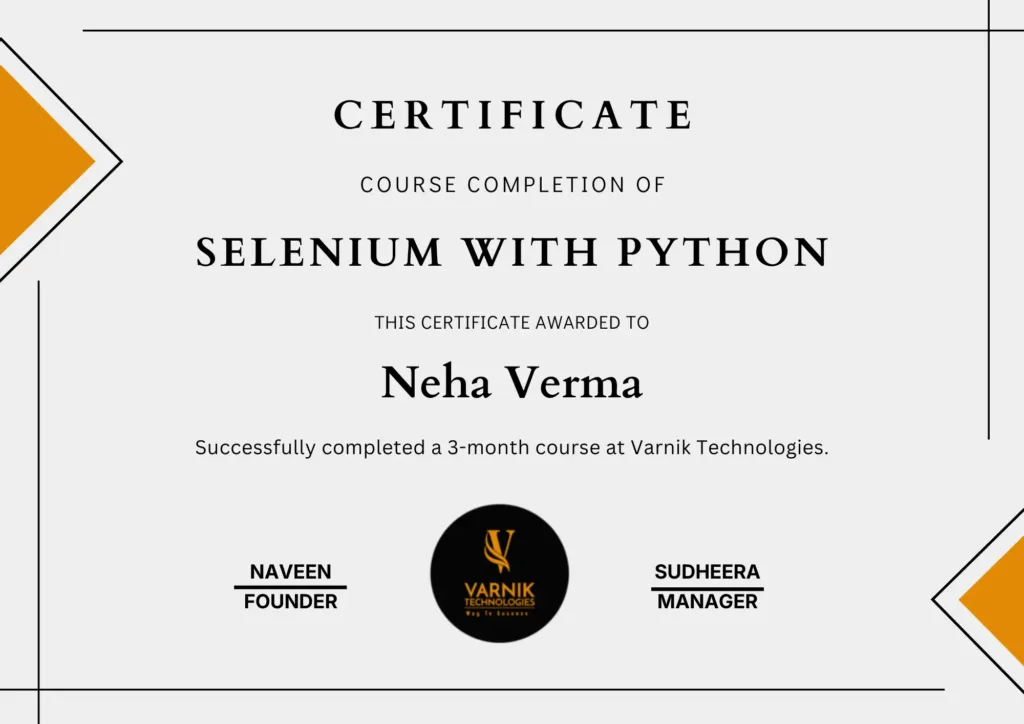
- Course Completion Certificate: You will receive a verifiable certificate from Varnik Technologies, validating your expertise in Selenium WebDriver, Java, and TestNG Frameworks. This certificate is recognized by our hiring partners.
- GitHub Portfolio: More valuable than a paper certificate is your code. By the end of the course, you will have a live GitHub repository containing:
- Your custom-built Hybrid Framework.
- Solved coding challenges (Java logic).
- Test scripts for the E-commerce live project.
- This portfolio acts as “Proof of Skill” during interviews.
Certification for Selenium With Java Training at Varnik Technologies
Placement & Career Support
We don’t just teach; we help you get hired. Our placement assistance program is rigorous and tailored to the Hyderabad market.
- Resume Transformation: We don’t just add keywords; we restructure your resume. We highlight “Framework Designing” and “CI/CD Integration” skills to ensure your profile gets shortlisted by ATS (Applicant Tracking Systems).
- Mock Interviews: You will undergo strict mock interviews with industry seniors. We grill you on Java collections, exceptions, and framework architecture so that the actual interview feels easy.
- Referral Network: Varnik Technologies has a strong alumni network working in companies like Deloitte, Wells Fargo, JP Morgan, and ValueLabs in Hyderabad. We actively push your resumes through internal referrals.
- Job Alerts: You will receive daily updates on walk-in drives and scheduled interviews specifically for Selenium professionals in Hitech City and Gachibowli.
Why Online Training is Best for Learners in Hyderabad
While Hyderabad is a tech hub, the logistics of attending daily offline classes can be draining.
- Beat the Cyberabad Traffic: The commute from residential areas (like Kukatpally, Miyapur, or Uppal) to training hubs (like Ameerpet or Madhapur) can take 2-3 hours during peak time. Our Online Training saves you this time, allowing you to practice coding instead of sitting in traffic.
- Learn While You Earn: Most of our students are working professionals with 9-to-6 jobs. Our batch timings (early morning or late evening) are designed so you can upgrade your skills without disturbing your work schedule.
- Cost-Effective: You save money on travel and accommodation (for outstation students). You get the same quality training as a physical classroom but at a more affordable fee structure and with the comfort of your home.
Frequently Asked Questions (FAQ)
1. Do I need to know coding/programming before joining this course?
No. We teach Core Java from scratch, assuming zero prior coding knowledge. We cover variables, loops, and OOPs concepts extensively before starting Selenium.
2. I am a Manual Tester with a 3-year gap. Can I switch to Automation?
Yes. Career gaps are acceptable if you can justify them with strong skills. We help you frame your gap as a “Skill Upgrade Period” and prepare you to answer technical questions confidently to overshadow the gap.
3. Is Selenium with Java better than Selenium with Python?
In the Hyderabad job market, 70-80% of job openings ask for Java + Selenium. While Python is easier to learn, Java offers more job opportunities and higher stability in enterprise projects.
4. Will you cover API Testing in this course?
This specific course focuses on Web UI Automation. However, we touch upon how to integrate API calls within a Selenium framework. We have a separate advanced module for full-stack API testing (RestAssured).
5. How much time does it take to learn Selenium?
Our course is 60 days long. However, mastering it depends on your practice. We recommend spending at least 1-2 hours daily practicing Java logic and Selenium scripts alongside the classes.
6. Do you provide recordings if I miss a class?
Yes. Every live session is recorded and uploaded to your student portal immediately. You get lifetime access to these recordings for revision.
7. Is this course suitable for non-IT graduates?
Absolutely. We have successfully trained students from B.Com, MBA, Civil, and Mechanical backgrounds. The key is your willingness to learn logic; the syntax is easy to pick up.
8. What is the difference between Selenium and Tosca?
Selenium is an open-source (free) tool that requires coding (Java/Python). Tosca is a paid, script-less tool. Most companies prefer Selenium because it is free and highly customizable, making it a more valuable skill for your career.
9. Will I get a job immediately after the course?
Placement depends on your practice and interview performance. We provide the skills, resume, and interview opportunities. Students who complete the assignments and projects diligently usually get placed within 1-3 months of course completion.
10. Can I attend a demo class before paying?
Yes! We offer Free Demo Sessions where you can interact with the trainer, check the teaching style, and see the course content before making a financial commitment.
